From Memento to Gone Girl, these masterful thrillers master suspense, deception, and unforgettable twists that keep you guessing until the final frame.
The best thrillers do more than build suspense. They challenge what you think you know. These are the films that quietly drop clues, shift perspectives, and pull the rug out from under the audience when least expected. From complex narratives like Memento to the lingering mystery of Sound of My Voice, they keep viewers engaged by blurring the line between truth and illusion. Rather than offering easy answers, these stories embrace uncertainty and reward close attention. Every twist, revelation, and misleading detail serves a purpose, making the experience all the more satisfying.
Here are 10 thrillers that keep you guessing from beginning to end and prove that unpredictability can be one of cinema’s greatest strengths.
1. ‘The Usual Suspects’ (1995)
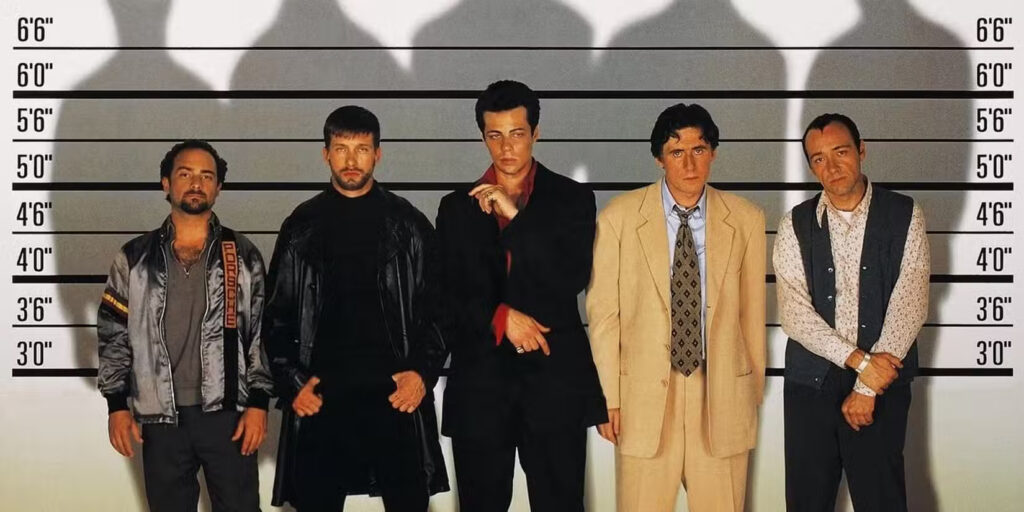
The Usual Suspects remains one of the most celebrated thrillers ever made, largely because of the way it plays with perception and keeps viewers questioning everything they see. The story follows Roger “Verbal” Kint, played by Kevin Spacey, a low-level con artist who finds himself the lone survivor of a deadly explosion aboard a ship. During a lengthy police interrogation, Verbal recounts the chain of events that led to the disaster, describing how a group of criminals became entangled with the feared and elusive crime lord Keyser Soze.
What makes the film so compelling is its narrative structure. The audience experiences the story entirely through Verbal’s version of events, which immediately creates an element of uncertainty. As the plot unfolds, subtle inconsistencies begin to emerge, and small details hint that not everything is exactly as it seems. Yet the film never gives away too much, allowing the mystery to build steadily until its unforgettable final moments. Written by Christopher McQuarrie, the screenplay is often praised for its clever construction and masterful use of misdirection. Every scene serves a purpose, and seemingly minor details gain new significance once the truth comes to light. The film’s ending does more than deliver a shocking twist. It completely reshapes the audience’s understanding of everything that came before, making a second viewing almost essential. It is easy to see why The Usual Suspects earned the Academy Award for Best Original Screenplay and continues to be regarded as a benchmark for modern thriller storytelling.
2. ‘The Invitation’ (2015)
The invitation is one of those rare thrillers that creates tension without relying on constant action or shocking twists. Directed by Karyn Kusama, this film follows Will, played by Logan Marshall Green, as he attends a dinner party hosted by his ex-wife Eden and her new partner David at the home they once shared. What begins as an uncomfortable reunion soon takes on a far more unsettling tone, as strange conversations and unusual behavior leave Will convinced that something is seriously wrong. The film’s greatest strength lies in the uncertainty it creates. Throughout the evening, Will’s suspicions are repeatedly dismissed by those around him, forcing both him and the audience to question what is really happening. Is there a genuine threat hiding beneath the surface, or is his grief and unresolved trauma shaping the way he sees the situation? The film never rushes to answer that question.
Kusama carefully builds suspense through small details, awkward social interactions, and an atmosphere that grows more unsettling with every scene. The tension continues to simmer until the truth finally comes into focus, delivering a payoff that is both shocking and deeply chilling. Underrated and remarkably effective, The Invitation is a masterclass in slow-burn thriller storytelling that keeps viewers guessing right until the end.
3. ‘Coherence’ (2013)
Coherence proves that a gripping thriller does not need a massive budget to leave a lasting impression. The film begins with a seemingly ordinary dinner party where a group of friends gathers for an evening together. However, when a comet passes overhead, strange events begin to unfold. Small disruptions soon turn into something far more unsettling as reality itself starts to shift, leaving the characters trapped in a situation they can barely understand.
What makes Coherence so effective is the way it throws both its characters and the audience into the same state of uncertainty. As the night progresses, familiar surroundings become increasingly distorted, and the group finds themselves confronting alternate versions of their own lives. Every new discovery raises even more questions, making it nearly impossible to predict where the story is headed. Directed with a minimalist approach, the film uses improvised dialogue and a naturalistic style to create an atmosphere that feels remarkably real. Rather than relying on visual spectacle, it builds tension through confusion, paranoia, and constantly shifting possibilities. Each revelation changes the audience’s understanding of what is happening, only for another twist to complicate things further. Coherence plays like a puzzle that keeps rearranging itself before the final pieces can fall into place, making it one of the most inventive and endlessly fascinating thrillers of recent years.
4. ‘Shutter Island’ (2010)
Few psychological thrillers create an atmosphere as unsettling and absorbing as Shutter Island. Directed by Martin Scorsese, the film is set in 1954 and follows U.S. Marshal Teddy Daniels, played by Leonardo DiCaprio, as he arrives at Ashecliffe Hospital. It is a psychiatric institution located on a remote island to investigate the disappearance of a patient. Accompanied by his partner Chuck Aule, Teddy begins questioning staff members and patients, but it quickly becomes clear that nothing about the hospital is straightforward. As the investigation deepens, Teddy finds himself facing resistance at every turn. A powerful storm cuts off access to the mainland, leaving him stranded on the island while disturbing memories and visions from his past begin to surface. What starts as a missing person case gradually transforms into something far more complex. It blurs the boundaries between truth, memory, reality, and paranoia.
One of the film’s greatest strengths is the way Scorsese places viewers directly inside Teddy’s perspective. The audience sees the world through his eyes, making it difficult to separate reality from delusion. Clues are scattered throughout the story, but they are presented in ways that support multiple interpretations. It ensures that every new revelation raises as many questions as it answers. While Shutter Island is often remembered for its famous twist, the real achievement lies in the journey leading up to it. The film carefully builds tension through its haunting atmosphere, psychological uncertainty, and growing sense of dread. Even after the final reveal, the story continues to linger. It encourages viewers to revisit its clues and debate what they have truly witnessed. That lasting ambiguity is what makes Shutter Island one of the most compelling thrillers of its era.
5. ‘The Prestige’ (2006)
The Prestige is a thriller that understands the art of deception better than most films. Directed by Christopher Nolan, it follows rival magicians Robert Angier and Alfred Borden, whose professional competition gradually turns into a dangerous obsession. What begins as a battle to create the ultimate illusion soon spirals into a ruthless game of secrets, sabotage, and sacrifice as both men attempt to outdo each other with increasingly ambitious tricks. At the center of their rivalry is The Transported Man, an illusion so extraordinary that it pushes both magicians to extreme lengths in pursuit of its secret. As their obsession deepens, the line between performance and reality becomes increasingly blurred. It raises the stakes with every new revelation.
What makes The Prestige such a rewarding thriller is the way it mirrors the structure of a magic act itself. Built around the concepts of The Pledge, The Turn, and The Prestige, the film constantly directs the audience’s attention where it wants it to go while quietly hiding crucial clues in plain sight. The answers are there from the beginning, but Nolan’s storytelling is so precise that most viewers never see them coming. More than a story about magicians and magic, The Prestige is a masterclass in misdirection. Every twist feels earned to the viewer, and every detail gains new meaning on a second viewing. It remains one of Nolan’s finest achievements and a perfect example of a film that stays one step ahead of its audience until the very end.
6. ‘Sound of My Voice’ (2011)
Sound of My Voice is the kind of indie thriller that quietly gets under your skin and stays there long after the credits roll. The film follows documentary filmmakers Peter and Lorna, who decide to infiltrate a secretive cult led by Maggie, a mysterious woman who claims she has traveled back in time from the future. Their original goal is straightforward. They want to expose her and reveal the truth behind her growing influence. However, the deeper they immerse themselves in the group, the harder it becomes to dismiss her claims.
As Peter and Lorna gain Maggie’s trust, they witness the unwavering faith of her followers and begin hearing predictions and details that seem strangely convincing. What initially appears to be another story about manipulation and belief gradually evolves into something far more intriguing. The film constantly challenges both its characters and its audience to question what is real and what is not.
Created by Brit Marling and Zal Batmanglij, Sound of My Voice contains many of the themes that would later define The OA. The sense of mystery, the exploration of faith, and the blurred boundary between skepticism and belief are all present here. Rather than providing clear answers, the film thrives on uncertainty, carefully maintaining ambiguity around Maggie’s true identity. One of its greatest strengths is that it refuses to confirm or deny her story outright. Every revelation creates new possibilities while raising even more questions. That uncertainty keeps the tension alive throughout the film and makes the experience surprisingly immersive.
The ending remains one of the most talked-about aspects of Sound of My Voice. Its abrupt conclusion may frustrate viewers looking for definitive answers, but it is also what makes the film so memorable. Instead of offering a neat resolution, the film invites audiences to revisit everything they have seen and decide for themselves what they believe. Few thrillers trust their viewers that much, and that confidence is part of what makes this film so compelling.
7. The Silence of the Lambs (1991)
The Silence of the Lambs remains one of the most influential thrillers ever made, blending psychological suspense with elements of horror in a way that still feels unsettling decades later. Directed by Jonathan Demme, the film follows FBI trainee Clarice Starling, played brilliantly by Jodie Foster, as she is tasked with helping track down a serial killer known as Buffalo Bill. Young and relatively inexperienced, Clarice enters a world filled with danger, manipulation, and disturbing secrets as she pursues a case that grows more terrifying with every step.
At the heart of the story is Dr. Hannibal Lecter, portrayed by Anthony Hopkins in one of cinema’s most unforgettable performances. A brilliant psychiatrist and imprisoned cannibal, Lecter becomes both a source of insight and a psychological threat, engaging Clarice in a series of tense conversations that reveal as much about her as they do about the investigation.
What makes the film so effective is its ability to balance procedural storytelling with genuine dread. Demme builds suspense through atmosphere, character dynamics, and carefully controlled pacing, while never losing sight of the emotional stakes driving Clarice forward. The film’s narrative remains gripping throughout, leading to a finale that delivers both tension and payoff. One sequence in particular has become legendary. As Buffalo Bill stalks Clarice through a darkened basement using night vision, the audience is left completely vulnerable, seeing the danger unfold while she remains unaware. It is a masterclass in suspense and a reminder of why The Silence of the Lambs is still regarded as one of the greatest thrillers of the 1990s and one of the rare films in the genre to achieve major Academy Award success.
8. ‘Memento’ (2000)
Memento is the film that introduced many viewers to Christopher Nolan’s fascination with time, memory, and unconventional storytelling. At its center is Leonard Shelby, played by Guy Pearce, a man suffering from short-term memory loss following a traumatic attack that also claimed the life of his wife. Unable to create new memories, Leonard navigates his life through a system of handwritten notes, Polaroid photographs, and tattoos etched onto his body, all designed to help him stay focused on his mission to find the person he believes is responsible.
What immediately sets Memento apart is its reverse chronological structure. Instead of moving forward, the story unfolds backward. It places the audience in the same disoriented position as Leonard. Each scene arrives without complete context, forcing viewers to constantly piece together information and reassess what they think they know. Just when a conclusion begins to form, another revelation shifts the perspective entirely. The film works as a gripping mystery, but its greatest achievement lies beyond the search for answers. Nolan uses Leonard’s condition to explore larger ideas about identity and self-deception. As the story progresses, questions emerge about how much of what Leonard believes is actually true and how much has been shaped by his own need for purpose. By the time the film reaches its final revelation, the mystery itself almost feels secondary. Memento becomes less about solving a crime and more about examining the stories people create to live with loss and regret. Thought-provoking and emotionally complex, as well as endlessly rewatchable, it remains one of the most inventive thrillers ever made and a defining work in Nolan’s career.
9. ‘Taxi Driver’ (1976)
Few films have captured loneliness, obsession, and social alienation as powerfully as Taxi Driver. Directed by Martin Scorsese, this psychological thriller follows Travis Bickle, a Vietnam War veteran played by Robert De Niro, whose growing disillusionment with the world around him gradually pushes him toward a dangerous breaking point. Working long nights as a taxi driver in New York City, Travis spends his days drifting through isolation, becoming increasingly detached from reality and consumed by his own distorted sense of purpose. What makes Taxi Driver so unsettling is how deeply it places viewers inside Travis’s mindset. Scorsese presents a character who sees himself as a force for change while slowly descending into paranoia and delusion. The result is a film that feels both intimate and deeply disturbing, forcing the audience to witness the gradual transformation of a troubled man into something far more dangerous.
Decades after its release, Taxi Driver remains remarkably relevant because of its exploration of anger, alienation, and the search for meaning in a fractured society. Travis is not portrayed as a traditional hero. Instead, he is a complex and deeply flawed character whose actions raise uncomfortable questions about violence and identity. The film also features one of the most iconic moments in cinema history. Standing alone in front of a mirror while preparing for his violent mission, Travis rehearses a confrontation and delivers the now legendary line, “You talkin’ to me?” It is a scene that perfectly captures the character’s fractured psyche and helps cement Taxi Driver as one of Scorsese’s most unforgettable films.
10. ‘Prisoners’ (2010)
Prisoners is a gripping thriller that refuses to offer easy answers. Directed by Denis Villeneuve, the film begins with the disappearance of two young girls from a quiet town, a tragedy that immediately throws several families into panic and despair. As the police launch an investigation, a suspect is quickly identified and taken into custody. However, when a lack of evidence forces authorities to release him, one father becomes convinced that justice has failed.
That father is Keller Dover, played by Hugh Jackman, whose desperation soon drives him down a dark and dangerous path. Refusing to accept the police investigation, Keller takes matters into his own hands and kidnaps the man he believes knows the truth. What follows is not a conventional revenge story but a disturbing examination of how grief, fear, and anger can consume a person.
One of the film’s greatest strengths is its refusal to glorify violence. Instead of presenting Keller’s actions as heroic, Prisoners exposes the devastating moral cost of his choices. Every decision pushes him further away from the person he once was, creating a tense and emotionally exhausting experience that constantly challenges the audience’s sympathies. At the same time, Detective Loki, portrayed by Jake Gyllenhaal, continues the official investigation, uncovering clues that gradually reveal a far larger and more disturbing mystery. Villeneuve masterfully builds suspense throughout, keeping viewers uncertain about the truth until the final act. Emotionally complex and relentlessly tense, Prisoners stands out as more than a crime thriller. It is a powerful study of desperation and moral compromise, culminating in a final twist that is as shocking as it is unforgettable.
11. ‘Oldboy’ (2003)
Oldboy is a thriller that leaves a lasting impact long after it ends. Directed by Park Chan-wook, the film follows Oh Dae-su, a man whose life is turned upside down when he is suddenly kidnapped and locked away in a private cell for 15 years. With no explanation for his imprisonment and no contact with the outside world, Dae-su is left to endure years of isolation while desperately searching for answers that never come. Just as mysteriously as he was taken, he is one day released. Given money, clothes, a phone, and a limited amount of time, Dae-su is tasked with discovering the reason behind his captivity within five days. Determined to uncover the truth, he begins to re-examine his past and pieces together clues that might explain the nightmare he has endured. Along the way, he forms a connection with a young woman named Mi-do, who becomes an important part of his search for answers.
What makes Oldboy such a compelling thriller is the way it places viewers directly inside Dae-su’s journey. The audience learns information at the same pace he does, creating a constant sense of uncertainty and tension. Every revelation appears to bring clarity, yet each answer only uncovers a deeper and more disturbing mystery beneath the surface. Park Chan-wook masterfully blends multiple genres throughout the film. At different moments, Oldboy seems like a revenge story, a psychological thriller, a mystery, and even a tragedy. Its layered storytelling keeps viewers engaged from beginning to end, while its striking visual style adds to the film’s emotional weight.
The final act delivers one of the most shocking revelations in modern cinema. More than a simple twist, it completely transforms the audience’s understanding of everything that came before. By the time the credits roll, Oldboy becomes a masterful film about guilt, consequences, and the devastating power of hidden truths.
12. ‘Gone Girl’ (2014)
Gone Girl is a thriller that constantly shifts the ground beneath its audience. Directed by David Fincher and adapted by Gillian Flynn from her bestselling novel, the film begins with the sudden disappearance of Amy Dunne on her fifth wedding anniversary. As investigators search for answers, suspicion quickly turns toward her husband, Nick, whose awkward media appearances and questionable behavior make him look increasingly guilty in the eyes of both the public and the police. The investigation uncovers a series of clues, including diary entries and evidence suggesting that the couple’s marriage had been falling apart for years. With each new revelation, the case appears to become clearer, and Nick finds himself trapped in a narrative that seems impossible to escape.
What makes Gone Girl so effective is its use of unreliable perspectives. Just when viewers think they understand the truth, the story takes another turn and forces them to rethink everything they have seen. The film never allows the audience to get comfortable, constantly challenging assumptions about its characters and their motivations. Beyond the mystery itself, Gone Girl offers a sharp commentary on media culture and public perception. It explores how stories are shaped, manipulated, and consumed, often blurring the line between reality and performance. That extra layer of social satire makes the film even more compelling. Rather than building toward a single shocking moment, Gone Girl thrives on sustained unpredictability. Every revelation changes the dynamic between its characters. The film very cleverly creates a tense and absorbing experience that keeps the audience guessing until the very end.
13. ‘The Game’ (1997)
The Game is one of David Fincher’s most underrated thrillers and a perfect example of his talent for keeping audiences off balance. The film follows Nicholas Van Orton, a wealthy and emotionally detached banker who receives an unusual birthday gift from his brother. The present is an invitation to participate in an immersive experience created by a company called Consumer Recreation Services. What begins as a strange game quickly turns into a nightmare. As Nicholas becomes increasingly involved, his money disappears, his home is compromised, and his grip on reality starts to weaken. Every attempt to uncover the truth only pulls him deeper into the mystery. The film’s greatest strength lies in its constant uncertainty. Fincher constructs a story where every event could either be part of the game or a genuine threat, making it impossible to know who can be trusted. That ambiguity creates relentless tension and keeps viewers questioning every twist. As the stakes continue to rise, The Game becomes increasingly intense, building toward a finale that feels both shocking and strangely satisfying. Despite Fincher’s impressive filmography, this remains one of his most overlooked works and one of his most entertaining thrillers.
How many of these have you watched? Pick any, and we guarantee that you won’t be able to look away for a moment!