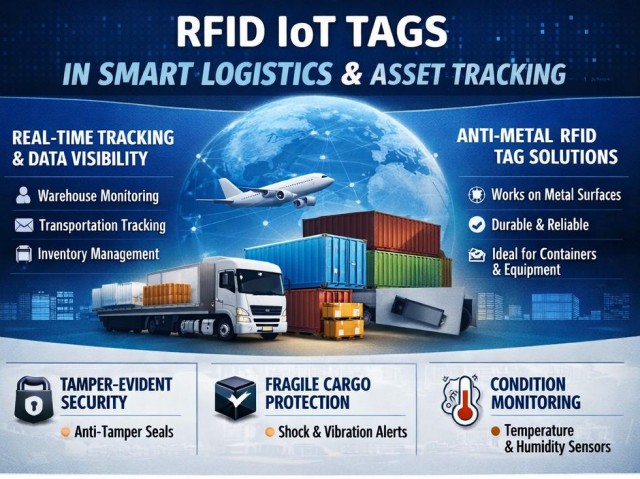
(Isstories Editorial):- Xiamen, Fujian Apr 10, 2026 (Issuewire.com) – Global supply chains are undergoing a profound transformation driven by digitalization, automation, and the demand for real-time visibility. In this evolving landscape, RFID IoT tags have become a cornerstone technology for enabling smarter logistics and more efficient asset tracking. Businesses across industries are increasingly adopting advanced RFID solutions to gain accurate insights into asset location, condition, and movement. Among these innovations, the growing application of anti-metal RFID tags for asset tracking demonstrates how modern RFID technologies are overcoming traditional limitations, delivering reliable performance even in complex environments such as metal-rich logistics hubs and industrial settings. From warehouses and transportation networks to distribution centers and last-mile delivery, RFID IoT tags are redefining how logistics systems are managed and optimized.
1. RFID IoT Tags: Powering the Evolution of Smart Logistics
More on Isstories:
- China cold chain RFID temperature sensor manufacturer highlighted at LogiMAT
- The Rise of RFID IoT Tags in Smart Logistics and Asset Tracking
- Global Energy Chaos Triggers LPG Shock: India’s Gobar (Bio) Gas Emerges as a Strategic Alternative
- MIKE.A Trading Corporation joins FasterCapital offers services through Upwork and sells books
- A Notable Woman Reexamines a Quiet Heroine of Scripture Through Cultural and Historical Insight
Smart logistics relies on accurate, real-time data to optimize operations. RFID IoT tags enable seamless tracking of goods throughout the entire supply chain, from manufacturing and warehousing to transportation and delivery.
Unlike traditional barcode systems, RFID tags do not require line-of-sight scanning, allowing for faster and more efficient data capture. This reduces manual labor and human error while significantly improving operational speed. In large-scale logistics environments, thousands of items can be scanned simultaneously, providing instant visibility into inventory levels and cargo movement.
Leading manufacturers continue to enhance RFID performance through advanced antenna design, durable tag structures, and stable communication technologies. By combining hardware innovation with IoT connectivity, RFID solutions are becoming more adaptable to complex logistics scenarios.
In addition, RFID IoT tags can be integrated with cloud-based platforms, enabling centralized data management and analytics. This allows logistics operators to monitor shipment status, predict delays, and optimize transportation routes, improving service reliability while reducing operational costs.
2. Enhancing Asset Tracking Across Logistics Operations
Asset tracking is a critical component of modern logistics systems. RFID IoT tags provide a reliable solution for tracking pallets, containers, vehicles, and high-value goods in real time across transportation networks.
Beyond identification, RFID tags can store and transmit operational data. Sensor-enabled tags can monitor environmental conditions such as temperature, humidity, and vibration, ensuring proper handling of sensitive cargo such as pharmaceuticals, food, and electronics.
In logistics hubs and warehouses, RFID tags are widely used to track handling equipment, storage units, and moving inventory. This improves asset utilization, reduces loss, and enhances workflow efficiency.
Specialized products such as anti-metal RFID tags ensure stable performance on metal surfaces, making them ideal for container tracking, vehicle identification, and equipment management in demanding logistics environments.
3. Improving Security, Anti-Tampering, and Fragile Goods Protection
Security and cargo integrity are major concerns in logistics operations, particularly when handling fragile or high-value goods. RFID IoT tags provide advanced capabilities to enhance both protection and traceability throughout the supply chain.
Tamper-evident RFID tags and seals can detect unauthorized access or package opening during transit. Once tampering occurs, the system can trigger alerts in real time, allowing logistics operators to respond immediately and minimize losses.
For fragile goods, RFID tags can be integrated with sensors that detect shock, vibration, or impact. This ensures that sensitive items such as glass products, precision instruments, or electronics are handled properly and any damage risks are recorded during transportation.
These technologies are especially valuable in industries such as pharmaceuticals, food logistics, and high-end electronics, where safety, compliance, and product integrity are critical.
4. Enabling Real-Time Data and Intelligent Decision-Making
One of the key advantages of RFID IoT tags is their ability to deliver real-time data, enabling smarter decision-making and improved logistics efficiency.
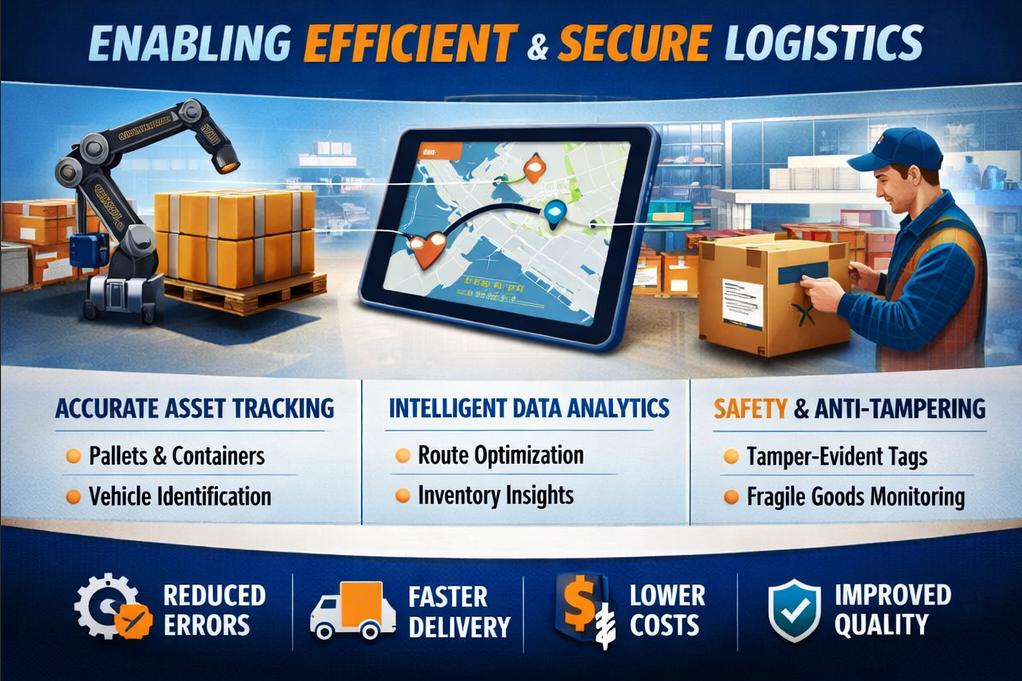
By integrating RFID systems with IoT platforms, logistics providers gain visibility into cargo movement, inventory trends, and operational performance. This supports demand forecasting, route optimization, and dynamic scheduling.
Real-time data also helps identify bottlenecks in transportation and warehousing processes, allowing companies to take proactive measures. This leads to faster turnaround times and better resource allocation.
Companies that combine hardware and software capabilities are well positioned to deliver complete logistics solutions, helping businesses build intelligent and responsive supply chain systems.
5. Supporting Efficiency and Waste Reduction in Logistics
Efficiency is a key objective in modern logistics, and RFID IoT tags play a significant role in reducing operational waste and improving resource utilization.
Accurate tracking of goods minimizes misplaced inventory, reduces handling errors, and prevents unnecessary duplication in shipping and storage. This directly lowers operational costs and improves delivery accuracy.
Enhanced visibility also reduces damage rates by ensuring proper handling procedures are followed throughout the logistics process. When combined with condition-monitoring sensors, RFID systems help maintain product quality and reduce losses caused by mishandling.
Durable RFID tags designed for logistics environments can withstand harsh conditions such as temperature fluctuations, dust, and mechanical stress, ensuring consistent performance across long-distance transportation and repeated handling cycles.
6. Customization and Integration for Logistics Applications
RFID IoT technology offers high flexibility, allowing solutions to be tailored to specific logistics scenarios.
RFID tags can be customized in terms of size, material, frequency, chip type, and functionality. For example, LED tags can support visual identification in large warehouses, while sensor-enabled tags enhance monitoring during transportation.
A key advantage lies in the ability to integrate RFID systems with logistics software platforms such as WMS (Warehouse Management Systems), TMS (Transportation Management Systems), and ERP systems. This ensures seamless data flow across the entire supply chain.
End-to-end solution providers can support deployment from initial design and testing to large-scale implementation, helping logistics companies accelerate digital transformation.
7. Driving Innovation in Global Logistics Systems
With continuous advancements in RFID and IoT technologies, solution providers are playing a crucial role in shaping the future of logistics.
Modern RFID manufacturers focus on integrating R&D, production, and system development to deliver scalable and reliable solutions. Large-scale manufacturing capacity, combined with strong engineering expertise, supports global logistics demands.
Through ongoing innovation, RFID solutions are becoming more intelligent, more durable, and more adaptable to complex supply chain environments. These advancements enable logistics providers to enhance visibility, strengthen security, and improve operational performance on a global scale.
Conclusion
The rise of RFID IoT tags is transforming smart logistics and asset tracking worldwide. As logistics systems demand greater efficiency, security, and transparency, RFID technology has become an essential component of modern supply chains.
With continuous improvements in IoT integration, sensor capabilities, and data analytics, RFID solutions will play an increasingly important role in logistics optimization.
By enabling real-time visibility, enhancing cargo protection, and supporting intelligent decision-making, RFID IoT tags are helping businesses build more resilient, secure, and efficient logistics networks for the future.
For more information about RFID IoT solutions and customized services, please visit:
https://www.rfidtagworld.com/
This article was originally published by IssueWire. Read the original article here.