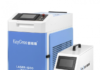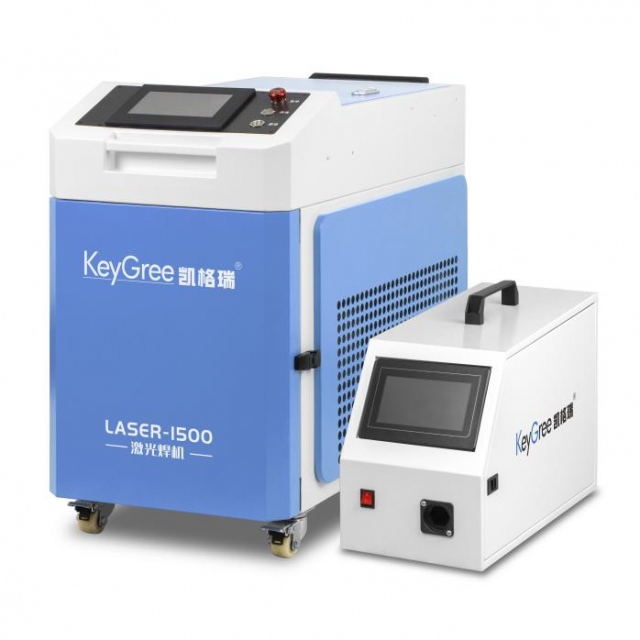
(Isstories Editorial):- Wenzhou, Zhejiang Apr 2, 2026 (Issuewire.com) – The HW series five in one laser welding machine from Keygree factory represents the forefront trend of current industrial equipment development. The HW-1500/2000/3000 models cover different power requirements, with a maximum welding thickness of up to 3mm and the ability to handle over 13 types of metals.
The working range of handheld operation can reach 10-15 meters, greatly expanding the workspace. The handheld laser welding machine is equipped with imported optical fibers, which make it flexible and convenient for outdoor welding. Users can weld workpieces at any angle through the operation mode of the handheld welding torch.
The most striking feature of this device is its five in one functional design: welding, weld cleaning, cutting, energy storage welding, cleaning and rust removal. Unlike traditional equipment that requires multiple machines to complete different processes, the five in one design can achieve multiple processes by switching modes.
More on Isstories:
- Five in one laser welding machine: innovative application of modern industrial “all-in-one surgical knife”
- Wanjia: Global Leading Veterinary Syringes Manufacturer of Livestock Productivity through Innovation and Precision
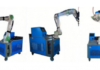
- Keygree KG Series Welding Robots: AC/DC Integrated Intelligent Welding for Multi-Material Manufacturing
- Global Launch: ARC-350H Ultra-Compact 350A Three-Phase Industrial Welder
- HAORUIDE Automation Equipment Enhances BB Cream Texture for Advanced Dimensional Makeup
Traditional problems
In traditional metalworking workshops, production lines are typically fragmented and occupied by various single-function equipment.
A typical metalworking workshop often requires CNC laser cutting machines for material preparation, independent argon arc welding or electric welding equipment for welding, and chemical immersion or sandblasting equipment for pre-weld cleaning and post-weld rust removal.
The problems arising from this “equipment island” model are obvious: large equipment footprint, frequent material handling, and low efficiency in process coordination, ultimately leading to high purchase and maintenance costs for enterprises, without a significant improvement in overall output efficiency.
Furthermore, controlling process quality is particularly difficult in actual welding operations. Statistics show that rework costs due to poor weld formation can account for 15%-20% of total production costs.
Whether it’s excessively high welds, weld depressions, undercut, or slag spatter, these common problems in traditional welding all seriously affect the appearance quality and structural strength of the product.
Multi-functional integrated solution
Five-in-one laser welding machines, exemplified by the Keygree HW series, are fundamentally changing this landscape. By integrating welding, weld cleaning, cutting, energy storage welding, and rust removal into a single unit, these machines achieve “one machine, multiple processes.”
At their core is advanced dual-oscillating welding torch technology, which allows the laser beam to oscillate and scan along a preset Z-shaped or circular trajectory. This not only widens the width of a single weld pass but also significantly improves weld strength by stirring the molten pool, effectively reducing welding defects.
The five-in-one equipment provides precise technical responses to specific problems encountered in traditional welding. For example:
High welding speed is a characteristic of laser welding, reaching speeds up to ten times that of traditional manual arc welding, with a minimal heat-affected zone, making it particularly suitable for precision welding of thin-walled parts (such as 0.5-1.5mm stainless steel plates).
The “fish scale welding” mode of the dual-oscillating welding torch can achieve uniform and aesthetically pleasing welds with a maximum width of 14mm, greatly improving the appearance quality.
The ability to quickly switch between multi-functional modules is particularly crucial. Switching from welding mode to weld cleaning or cutting mode requires only a nozzle change and takes less than 20 seconds.
Expanding application scenarios
The value of this integrated solution is becoming increasingly apparent in several industries sensitive to process flexibility and overall cost.
In the new energy vehicle sector, from energy storage welding of battery modules and pre-weld laser cleaning of IGBT module copper busbars to welding and repair of motor housings, the five-in-one equipment can cover multiple key aspects of production and maintenance, helping to build an efficient and clean production chain.
For industries such as pressure vessels, heat exchangers, and HVAC, the welding of core components such as manifolds places extremely stringent requirements on sealing, strength, and deformation control.
The five-in-one equipment’s low heat input, handheld flexibility, and precise control characteristics enable it to handle complex welding tasks involving multi-branch pipes and small spacing, solving problems such as deformation and low efficiency that are easily caused by traditional brazing or TIG welding.
In scenarios such as metal product processing, on-site engineering maintenance, and mold repair, the equipment’s advantages of “portability” and “multi-functionality” are further amplified.
Operators can carry the equipment to construction sites, workshops, or maintenance areas, flexibly switching functions to meet different needs, completing all tasks from cutting and blanking, welding and assembly to surface cleaning, realizing a “mobile mini processing station”.
Future Outlook
As industrial manufacturing continues to evolve towards flexibility, intelligence, and green practices, the integrated technology approach represented by the five-in-one laser welding machine is evolving from solving specific process problems to becoming a driving force for reshaping production processes.
For SMEs, this means achieving comprehensive processing capabilities comparable to large enterprises with lower initial investment and factory space requirements, significantly enhancing their competitiveness.
In the future, this type of equipment will be more deeply integrated into intelligent manufacturing systems. By integrating intelligent modules such as visual inspection, digital twins, and adaptive control, it will enable real-time monitoring of welding quality, automatic optimization of process parameters, and full traceability of production data.
From an environmental perspective, laser cleaning replaces chemical rust removal and sandblasting, fundamentally eliminating pollution problems caused by harmful waste liquids and dust, and is a reliable path to achieving green manufacturing.
This article was originally published by IssueWire. Read the original article here.