(Isstories Editorial):- Xian, Shaanxi Mar 27, 2026 (Issuewire.com) – Tungsten purity at 99.95% minimizes defects in aerospace propulsion and radiation-shielding parts. Impurities such as Fe, Mo, and Ni disrupt grain boundaries in high-purity tungsten powder, reducing mechanical strength and fatigue resistance. In electronics, trace elements cause electrical leakage and reduced lifespan in semiconductor contacts. Batteries and fuel cells require ultra-pure tungsten trioxide powder to prevent catalytic poisoning, ensuring stable electrochemical performance and maximizing energy conversion efficiency. Precision components for defense and medical imaging depend on strict impurity control for durability and consistent material behavior.
Challenges in Tungsten Purity Testing and Impurity DetectionIndustry Demands for Purity Testing
High-purity tungsten powder–99.95%–is essential for powder metallurgy and tungsten trioxide powder applications in catalysts, electronics, batteries, and fuel cells. Customers demand rigorous tungsten content measurement and tungsten powder purity certification from manufacturers for industrial use. Trace elements such as Fe, Mo, and Ni must be quantified in each batch; levels above 25-50 ppm degrade electrical, mechanical, and catalytic properties. In tungsten trioxide for catalysts, impurities drive phase instability and reduce performance in battery electrodes and capacitors. Suppliers must show documented evidence of impurity control for high-purity tungsten powder for industrial use and tungsten trioxide powder applications, as purchasing managers now specify batch-certified impurity limits.
More on Isstories:
- XRF Determination of W, Fe, Mo, Ni in 99.95% High-Purity Tungsten
- LMS Garage Doors Solidifies Reputation as Leading Repair Expert in Citrus Heights
- Lada Niva 1.7L Fuel Pump Replacement: How the KS-380206 Electric Fuel Pump Delivers OEM-Level Reliability
- Holy Micro! LLC Showcasing Absolute AoA and SkyVoice Systems at SUN ‘n FUN 2026 – Hangar B, Booths 27 – 28
- As London’s Nightlife Violence Reaches Critical Levels Imperial Launches Capital-Wide Bouncer Service
Traditional Purity Verification Techniques
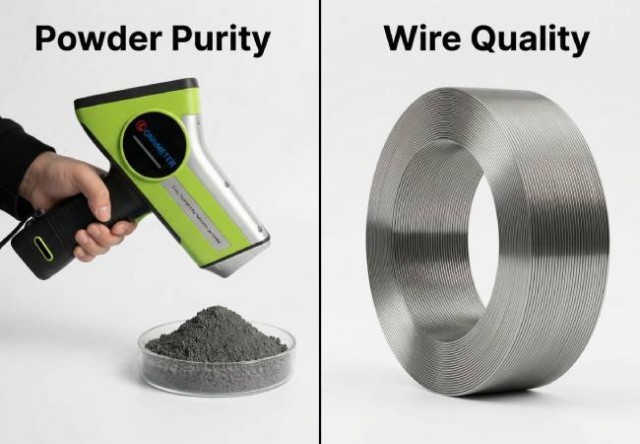
Chemical wet methods require dissolution of tungsten metal in strong acids and multi-step sample prep. This delays powder certification by days and introduces error through incomplete dissolution and contamination. ICP-OES and ICP-MS detect low impurity levels, but these laboratory techniques are not feasible for incoming inspection or routine process control. XRF has become the industry standard for rapid tungsten metal content analysis: it is non-destructive, processes powder and solid samples directly, and delivers trace-level readings for Fe, Mo, and Ni within minutes. Modern XRF, as integrated in the Lonnmeter analyzer, achieves repeatability of <1% for major elements and quantifies Ni, Fe, Mo down to 10 ppm in bulk tungsten. XRF offers analysis throughput of over 30 samples per hour, supporting high-purity tungsten powder suppliers in meeting QC requirements and enabling tungsten powder for powder metallurgy to be verified in-line.
Advanced Modern Rapid XRF Analysis in Tungsten Quality AssuranceHow XRF Works for Tungsten Alloys
X-ray fluorescence (XRF) utilizes high-energy X-rays to excite atoms in solid high-purity tungsten alloys. Tungsten, iron, molybdenum, and nickel atoms emit secondary X-rays at distinct energies; detectors capture these signatures to quantify elemental concentrations. XRF distinguishes between tungsten’s dominant emission lines and trace impurity signals, enabling reliable impurity detection even below 0.01% in 99.95% tungsten matrices. .
Benefits of XRF in High-Purity Verification
XRF delivers results within minutes, requiring minimal specimen preparation–only surface smoothing or powder homogenization. Non-destructive testing preserves valuable high-purity tungsten powder samples. Robust calibration protocols ensure repeatability in tungsten content measurement, supporting compliance and batch verification for suppliers and buyers. Trace element accuracy, even for Fe, Mo, Ni in tungsten trioxide powder, streamlines purity testing methods in metals and electron device workflows. Automated reporting and digital data archiving enhance traceability across production, shipment, and procurement cycles.
Lonnmeter XRF Alloy Analyzer: Advanced Solution for Content and Purity Verification
The Lonnmeter XRF Alloy Analyzer supports high-purity tungsten powder and tungsten trioxide powder analysis, delivering direct quantification of W, Fe, Mo, and Ni alongside wide element compatibility for powder metallurgy, catalysts, and battery raw materials. Measurement employs energy-dispersive X-ray fluorescence, optimized for trace impurity detection in 99.95% tungsten matrices. W is measurable from ppm to nearly 100%, with <0.5% typical error for bulk content, enabling high-precision tungsten content measurement critical to supplier certification and process control.
The analyzer operates with a small measurement spot and sealed sample chamber, facilitating clean, non-destructive purity testing in solid powders or pressed pellets. Throughput exceeds 50 samples per hour, with per-sample analysis in 30 seconds. Precision and repeatability align to industrial QMS standards; calibration supports routine high-purity tungsten powder testing and ensures tungsten powder purity certification records remain robust.
The user interface is touchscreen-based, supporting automated reporting, batch export, and traceable data storage for QC labs and incoming inspection. Portability enables deployment in both benchtop and field settings. The integrated material library covers over 1,000 alloys, minimizing operator error. The device’s layout simplifies maintenance, and error-prevention protocols support high-purity tungsten powder suppliers and downstream users in advanced industries.
How to Request a Quote for the Lonnmeter XRF Alloy Analyzer
Initiate requests via contact form on the Lonnmeter website. Submit material details, sample types, target elements, throughput, and preferred analyzer options. Technical consultation refines application: tungsten trioxide powder applications, alloy matrix compatibility, sample preparation, and detection limits. Receive documentation outlining solution scope, lead times, accessory kits, after-sales, and demo support. Price quotation and technical datasheets are provided following review of submitted specifications, enabling rapid procurement aligned to purity testing in metals workflows.
FAQs
How does XRF analyzer measure tungsten content and impurities?
An XRF analyzer directs X-rays at the tungsten powder; atoms absorb energy and emit secondary X-ray signals unique to each element. No digestion or wet chemistry is required. All data is automatically logged for tungsten powder purity certification and process control.
Why is tungsten trioxide powder critical for advanced applications?
Tungsten trioxide powder’s high purity and consistent particle size impart superior electrical conductivity and chemical inertness, essential for lithium-ion battery cathodes, smart window coatings, and high-density ceramic capacitors. Its catalytic efficiency accelerates gas-sensing and fuel cell reactions. Any contamiation, such as iron or nickel, degrades electrical characteristics and application longevity.
What purity level is standard for tungsten trioxide powder in demanding industries?
Electronics and energy manufacturers specify tungsten trioxide powder with 99.995% purity. This guarantees minimal metallic contamination, crucial for producing defect-free piezoelectric ceramics, high-voltage capacitors, and specialty catalysts.
LONNMETER GROUP
[email protected]
029-88661865
Operations Center:Room 202, Unit 4, Building 1, Jiaotong Nanyuan, No.12 Chang ‘an South Road, Yanta District, Xi ‘an City, Shaanxi Province
https://www.lonnmeter.com/
This article was originally published by IssueWire. Read the original article here.