(Isstories Editorial):- Xiamen, Fujian Mar 19, 2026 (Issuewire.com) – China is home to thousands of factories offering CNC machining services. For procurement engineers and product developers, the challenge is not finding a supplier. finding a reliable CNC machining factory in China. The factory must consistently deliver high-quality parts across multiple production batches.
In industries where reliability is critical–such as automotive safety components, aerospace structures, and medical devices–consistency, traceability, and process stability are essential. A CNC supplier might successfully manufacture a prototype once, but maintaining the same tolerance control, material integrity, and surface quality across repeated production cycles requires disciplined systems and engineering oversight.
This is why internationally recognized quality certifications have become the first screening threshold when selecting a CNC machining partner in China. Certifications such as ISO9001:2015 and IATF16949:2016 are not optional credentials; they represent verified frameworks for process control, documentation, and traceability.
More on Isstories:
- How to Choose a Certified CNC Machining Factory in China
- Jasmine: The Global Supplier Of Custom Glass Bottles and Jars Redefining Premium Packaging – From China to the World
- China CNC Milling Manufacturer DAZAO to Attend Metalloobrabotka 2026
- China Best Automated Flat Air Grinder With Low Noise: How JINGXIN Enhances Grinding Accuracy
- Hansen Surfboards: Encinitas’ Legendary Surf Shop Delivers Premium Gear for Every Wave and Lifestyle
Xiamen Dazao Machinery Co., Ltd., operating under the brand DAZAO, was founded in 2000 and operates as a certified CNC machining factory holding both ISO9001:2015 and IATF16949:2016 certifications. ISO9001 establishes the foundation of quality management systems, while IATF16949 extends those requirements with stricter automotive-grade process control, risk management, and traceability standards. Together, they form an engineering discipline that allows machining operations to remain stable and verifiable over repeated production cycles.
Understanding how such certifications translate into practical manufacturing capability is the first step in choosing a reliable CNC machining factory in China.
How to Evaluate a CNC Machining Factory in China
Selecting the right CNC supplier requires more than reviewing equipment lists or quoting prices. When choosing a CNC machining factory in China, buyers typically evaluate three key factors:
- Process capability – the ability to machine complex parts with tight tolerances
- Quality system – certified processes that ensure consistency and traceability
- Engineering support – the ability to provide DFM feedback before production
Process capability determines whether a supplier can handle complex geometries and maintain dimensional stability. Advanced factories rely on multi-axis CNC machining to reduce setup errors and improve precision.
A certified quality system such as ISO9001 or IATF16949 ensures standardized production processes, inspection procedures, and full traceability.
Engineering support plays a critical role in early-stage development by identifying design risks and improving manufacturability before mass production begins.
Key CNC Machining Capabilities Every Reliable Supplier Should Have
A strong CNC machining partner should demonstrate not only machining capacity but also the ability to apply the right technology to specific engineering problems.
Multi-Axis Strategy: Why Fewer Setups Matter More Than More Axes
Multi-axis machining is often misunderstood as simply a sign of advanced equipment. In reality, its main value lies in improving repeatability and dimensional consistency.
Three-axis machining is suitable for planar milling operations, drilling, and two-dimensional contours. Four-axis machining introduces a rotary axis that allows machining on multiple sides of a part within a single setup. Five-axis machining extends this capability further by enabling the cutting tool to approach the workpiece from nearly any direction.
The practical advantage of five-axis CNC machining is the ability to machine complex geometries with fewer setups. Each additional setup in traditional machining introduces alignment uncertainty. By machining multiple faces in a single clamping operation, manufacturers can maintain a unified reference system and reduce cumulative positioning errors.
This approach is particularly important for robotic interface components, where several mounting surfaces must align precisely for accurate motion and load transfer.
For example, DAZAO has established a dedicated sample production department that supports rapid prototyping within several working days, while providing dimensional inspection feedback to verify manufacturability before mass production.
Material Coverage: Matching Alloys to Applications
Another indicator of a capable CNC machining factory in China is its experience working with a wide range of materials. Different industries require different combinations of strength, corrosion resistance, thermal conductivity, or biocompatibility.
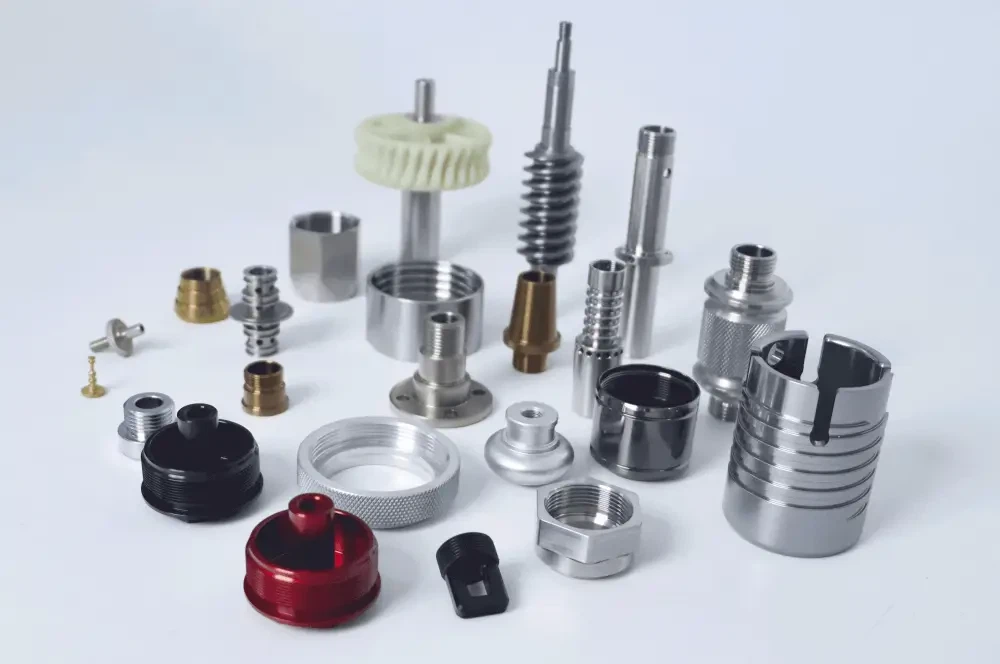
Aluminum alloys such as 6061 and 7075 are commonly used in consumer electronics housings, drone frames, and lightweight structural components. Stainless steels including 303, 304, and 316 are frequently selected for medical instruments and marine equipment due to their corrosion resistance. Brass alloys like C360 are widely used for electrical connectors, while copper grades such as 101 and 110 are valued for high thermal conductivity in heat dissipation components.
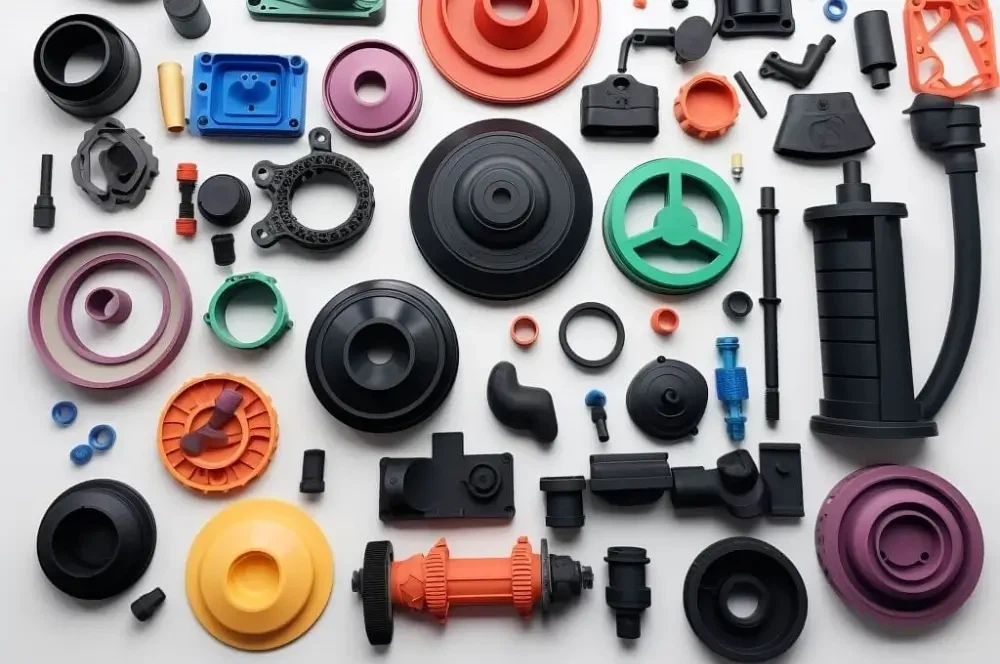
Engineering plastics are equally important in modern manufacturing. Materials such as ABS support functional housings, POM (Delrin) is widely used for gears and mechanical components, polycarbonate serves optical or transparent applications, and PEEK is used in aerospace and medical applications where high strength and temperature resistance are required.
A CNC machining partner capable of working with both metals and engineering plastics can support multiple stages of product development, from prototypes to production components.
Surface Finishing: From Machined Parts to Application-Ready Components
Surface finishing transforms a machined component from a raw functional part into a finished product ready for real-world use. Different finishing techniques influence corrosion resistance, wear resistance, appearance, and surface texture. The surface finishing services provided by DAZAO form a complete, closed-loop system with the CNC machining capabilities, ensuring a seamless, high-quality transition from raw part to final component.
As-milled surfaces are suitable for functional testing or internal components where aesthetics are less critical. Bead blasting creates a uniform matte surface texture and removes machining marks. Anodizing treatments, particularly Type II and Type III anodizing for aluminum, form protective oxide layers that significantly improve corrosion and wear resistance.
Powder coating provides durable coatings with controlled color matching, often specified using RAL color standards. These finishing processes allow machined parts to meet both functional and aesthetic requirements across industries such as robotics, marine equipment, and industrial machinery.
Why Quality Certifications Matter in CNC Machining
Quality certifications provide more than documentation. They represent structured systems that guide how machining operations are planned, executed, and verified.
Process Control with Material Sensitivity
Different materials respond differently to machining conditions. Stainless steel, for example, tends to work-harden during cutting if tools lose their sharp cutting engagement. It also has relatively low thermal conductivity, meaning heat can accumulate at the cutting zone.
Effective machining therefore requires optimized cutting parameters, proper tool paths, controlled coolant delivery, and systematic tool management. Establishing process parameter libraries for different materials allows machining operations to remain consistent from batch to batch.
Documentation-Led Traceability
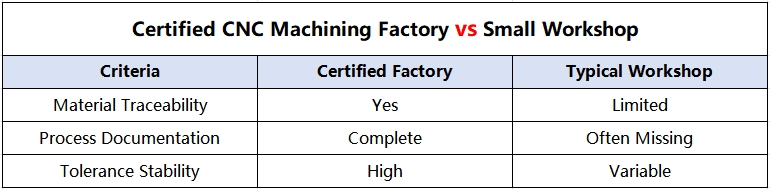
Traceability is another critical advantage of certified manufacturing environments. Each batch of material can be linked to its original production source through material certificates that include heat numbers identifying the smelting batch.
Dimensional inspection reports document measurement results for critical features, often supported by coordinate measuring machines. Process control records track how key dimensions are maintained during production. Environmental compliance documentation such as RoHS declarations confirms regulatory compatibility, while packaging records ensure consistency in logistics and product protection.
This documentation framework allows every delivered component to be traced through the manufacturing chain.
First Article Inspection and Design for Manufacturability
Before full production begins, first article inspection verifies that the initial manufactured component matches the engineering drawing requirements. Dimensional measurements confirm whether tolerances are achievable under actual machining conditions.
During this stage, engineering teams also provide design-for-manufacturability feedback. Deep cavities may require adjusted depth-to-width ratios to prevent tool vibration. Internal corners may need radii compatible with available cutting tools. Non-essential tight tolerances can sometimes be relaxed to reduce machining complexity and cost.
These adjustments help ensure that the design can transition smoothly from prototype to production.
Typical Industries Served by Certified CNC Machining Factories
Certified CNC machining manufacturers often support industries where reliability and traceability are essential.
In the automotive sector, components such as sensor housings and transmission valve blocks must meet strict traceability and process control requirements consistent with IATF16949 standards.
In aerospace applications, lightweight aluminum brackets and connectors must meet strict material certification and dimensional stability requirements.
Medical device manufacturing relies on precise machining for surgical instrument handles and high-performance polymer components such as PEEK parts, where cleanliness and dimensional accuracy are critical.
Robotics manufacturers require joint components and interface parts with highly consistent mating surfaces to ensure repeatable motion and mechanical reliability.
New energy industries rely on CNC machining for battery cooling plates, heat dissipation components, and electrical connectors where thermal performance and dimensional precision must be carefully balanced.
Conclusion
Choosing a certified CNC machining factory in China ultimately means selecting a partner capable of delivering consistent, traceable, and verifiable manufacturing results.
With over two decades of experience, DAZAO combines multi-axis CNC machining, certified quality systems, and engineering-driven production processes to support complex industrial applications.
Contact our engineering team today to discuss your project requirements and receive professional technical support.
More information about the company’s services and engineering capabilities can be found at www.partengineer.com.
Xiamen Dazao Machinery Co., Ltd.
[email protected]
N0.153, Tong’an Garden, Tong’an Industry Concentration Zone, Xiamen, Fujian, China
https://www.partengineer.com/
This article was originally published by IssueWire. Read the original article here.