(Isstories Editorial):- Hangzhou, Zhejiang Mar 4, 2026 (Issuewire.com) – In the complex ecosystem of industrial automation and energy infrastructure, the smallest components often bear the heaviest responsibility for system integrity. Among these, cable glands serve as the critical interface between electrical equipment and the external environment. As a leading Certified Metal Cable Gland Manufacturer, BEISIT has observed a growing disparity in the global market between rigorously tested components and generic “standard” alternatives. Selecting the right cable entry system is no longer merely a procurement decision; it is a fundamental commitment to operational safety and the long-term viability of high-value industrial assets.
The Benchmark of Excellence: Understanding the Power of CertificationCertified Reliability
Certified cable glands are engineered to meet stringent international standards, such as UL, CE, and ATEX, ensuring they can withstand extreme mechanical stress and environmental hazards. These certifications act as a technical guarantee that the product will maintain its ingress protection (IP) rating and strain relief capabilities under continuous load. When a manufacturer like BEISIT invests in national and international benchmarking, it provides engineers with the peace of mind that every connection point is a fortified link in their power or data network, capable of preventing moisture ingress, dust contamination, and accidental cable pull-outs.
More on Isstories:
- Certified vs. Standard: Why Your Choice of Cable Glands Matters for Safety and Longevity
- Pattaya Land Accelerates Expansion in 2026 With New Brand Launches and Record Growth
- Detroit Hip-Hop Takes Center Stage at Official SXSW Showcase
- Final Phase: Luxury Move-In Ready Villa in Panama’s Exclusive Marvalley Community
- The Ultimate Buyer’s Guide: How to Select a Certified Explosion-proof Junction Box Exporter
Non-Certified Risks
Conversely, the market is frequently saturated with non-certified or “standard” glands that lack verified performance data. These inferior products often utilize recycled alloys or low-grade elastomers that degrade rapidly when exposed to UV radiation, extreme temperatures, or chemical solvents. The absence of a certification seal often masks structural weaknesses that lead to catastrophic failures. In high-stakes environments like wind farms or hydrogen storage facilities, a single cracked seal in a non-certified gland can allow corrosive elements to penetrate sensitive electronics, leading to expensive downtime, equipment loss, or even fire hazards.
Material Integrity and the Longevity EquationPremium Metallurgy
High-quality metal cable glands, typically forged from brass, stainless steel, or specialized aluminum alloys, offer superior thermal stability and electromagnetic compatibility (EMC). These materials are chosen for their ability to provide consistent grounding and shielding, which is essential in modern industrial environments filled with electronic noise. By employing advanced surface treatments and precision machining, certified manufacturers ensure that the threading and clamping mechanisms remain functional for decades, even in the salt-mist conditions of offshore platforms or the vibration-heavy settings of rail transit.
Compromised Materials
On the other hand, choosing substandard components to save on initial capital expenditure often results in a significantly higher total cost of ownership. Poorly manufactured metal glands may suffer from galvanic corrosion or “cold welding” of threads, making future maintenance or cable upgrades nearly impossible without damaging the enclosure. Furthermore, low-quality clamping rings often lose their elasticity over time, leading to a loss of the airtight seal. This degradation is a silent threat; by the time a leak is detected, the internal circuitry of the connected machine is often already beyond repair, proving that “standard” glands are a liability rather than a saving.
Precision Engineering: The Technical Edge of Certified SolutionsInnovative Design
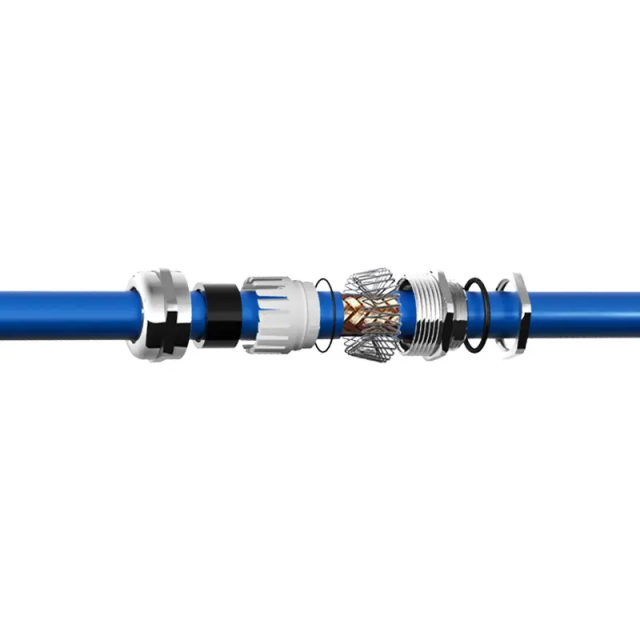
The technical superiority of a certified metal cable gland lies in its internal architecture. Leading innovators in the field have developed modular clamping inserts that accommodate a wide range of cable diameters while providing uniform pressure distribution. This prevents “cold flow” or deformation of the cable jacket, which is a common cause of electrical shorts. In sectors like new energy vehicles (NEV) and medical equipment, where signal integrity is paramount, these precision-engineered glands incorporate specialized EMC springs that ensure 360-degree contact for effective shielding against radio frequency interference.
The Generic Manufacturing
In contrast, generic glands often rely on a “one-size-fits-all” approach that compromises on precision. Loose tolerances in the manufacturing process can result in uneven pressure on the cable, leading to localized stress points that eventually rupture the insulation. Without the rigorous R&D and testing protocols adopted by industry leaders, these products cannot guarantee performance across diverse frequencies or voltages. In the context of industrial automation control systems, using such unverified hardware introduces a variable of unpredictability that can undermine the reliability of the entire automated line.
Conclusion
The choice between a certified metal cable gland and a standard alternative is a choice between proactive risk management and reactive crisis control. As demonstrated by the rigorous standards upheld by industry leaders, certification is the bridge between a component that merely “fits” and one that “protects.” For industries ranging from rail transit to hydrogen energy, the longevity of the system depends on the integrity of its smallest parts. Investing in certified solutions is an investment in the safety of personnel, the protection of equipment, and the continuity of global industrial progress.
The global industrial landscape is currently witnessing a significant shift toward high-reliability components, driven by the rapid expansion of renewable energy and smart manufacturing. As the primary drafting unit for national standards in its sector, BEISIT has positioned itself at the forefront of this transition. By focusing on “import substitution,” the company provides high-end certified solutions that match or exceed the performance of traditional Western brands. This movement is not just about cost-efficiency; it is about localizing innovation and ensuring that critical infrastructure in North America, Europe, and Asia is supported by components that meet the highest global benchmarks. The demand for reliable industrial connectors is expanding beyond traditional boundaries, necessitating a robust global supply chain. With R&D centers in Shenzhen and sales subsidiaries in Germany, Japan, and Russia, the industry is moving toward a model where technical support and product availability are localized for maximum efficiency. This global footprint allows for the cross-pollination of technical standards, ensuring that a cable gland used in a European wind turbine meets the same rigorous safety criteria as one installed in a Singaporean data center. For more information on high-performance cable entry systems and industrial connectors, visit the official website: https://www.beisitelectric.com/
This article was originally published by IssueWire. Read the original article here.