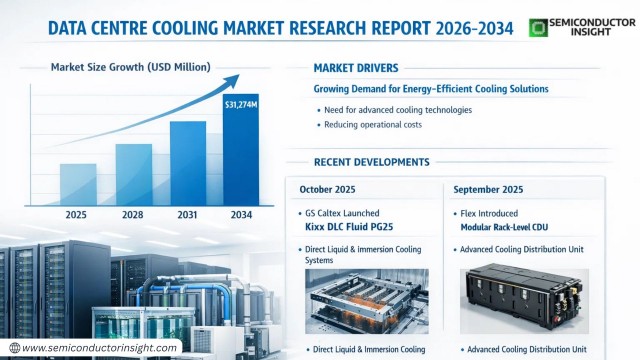
The market, valued at USD 10,149 million in 2025, is projected to grow at a CAGR of 17.6%, reaching USD 31,274 million by 2034, driven by the rise of AI-powered, high-density data centers requiring advanced liquid and immersion cooling solutions.
(Isstories Editorial):- Pune, Maharashtra Feb 26, 2026 (Issuewire.com) – Data centre cooling market represents the global industry which is focused on technologies, systems, and services that regulates temperature, manage heat loads, and maintain optimal operating conditions inside data centres. As data centres consume nearly 1% to 2% of global electricity annually and cooling alone accounts for approx. 30% of a facility’s total energy usage, thermal efficiency has become a mission critical priority rather than just an operational requirement.
More on Isstories:
- Data Centre Cooling Market to Surpass USD 31,274 Million by 2034 amid Steady 17.6% CAGR Growth
- Amplysphere OÜ: AI is Redefining Social Engagement in 2026
- GESTER: China Top PPE Testing Equipment Company Leading Global Safety Standards
- WinterGreen Synthetic Grass Completes 18-Hole Putting Course – Driving Range Field at Cowboys Golf Club
- New York Fashion Summit Signals Growing Industry Focus on Regeneration and Circular Systems
Further, the market is growing quickly as a result of the deployment of 5G, the expansion of edge data centres, also hyperscale cloud computing, and the explosive increase of artificial intelligence workloads. Previously falling between 5 and 10 kW, rack densities are now often beyond 30 kW, with AI training clusters in advanced environments surpassing 80 kW per rack.
According to Semiconductor Insight, at a compound annual growth rate (CAGR) of 17.6%, the market is expected to grow from its estimated USD 10,149 million in 2025 to USD 31,274 million by 2034, this growth will be primarily driven by the increasing deployment of high density racks, the growing demand for liquid and immersion cooling technologies, and more stringent global energy efficiency regulations that aim to lower data centre power consumption and carbon emissions are the main primary factors of this aimed market.
Some major sharp increase in processing intensity generates substantial heat loads, pushing operators to adopt advanced liquid cooling and hybrid cooling systems. For example, major cloud operators such as Amazon Web Services and Microsoft are investing heavily in energy-efficient cooling architectures to support AI-driven infrastructure while meeting aggressive sustainability commitments.
This report aims to provide a comprehensive presentation of the global market for Data Center Cooling, with both quantitative and qualitative analysis, to help readers develop business/growth strategies, assess the market competitive situation, analyze their position in the current marketplace, and make informed business decisions regarding Data Center Cooling.
Stay ahead with the Most Recent Market Insights Report Here: https://semiconductorinsight.com/report/data-center-cooling-market/
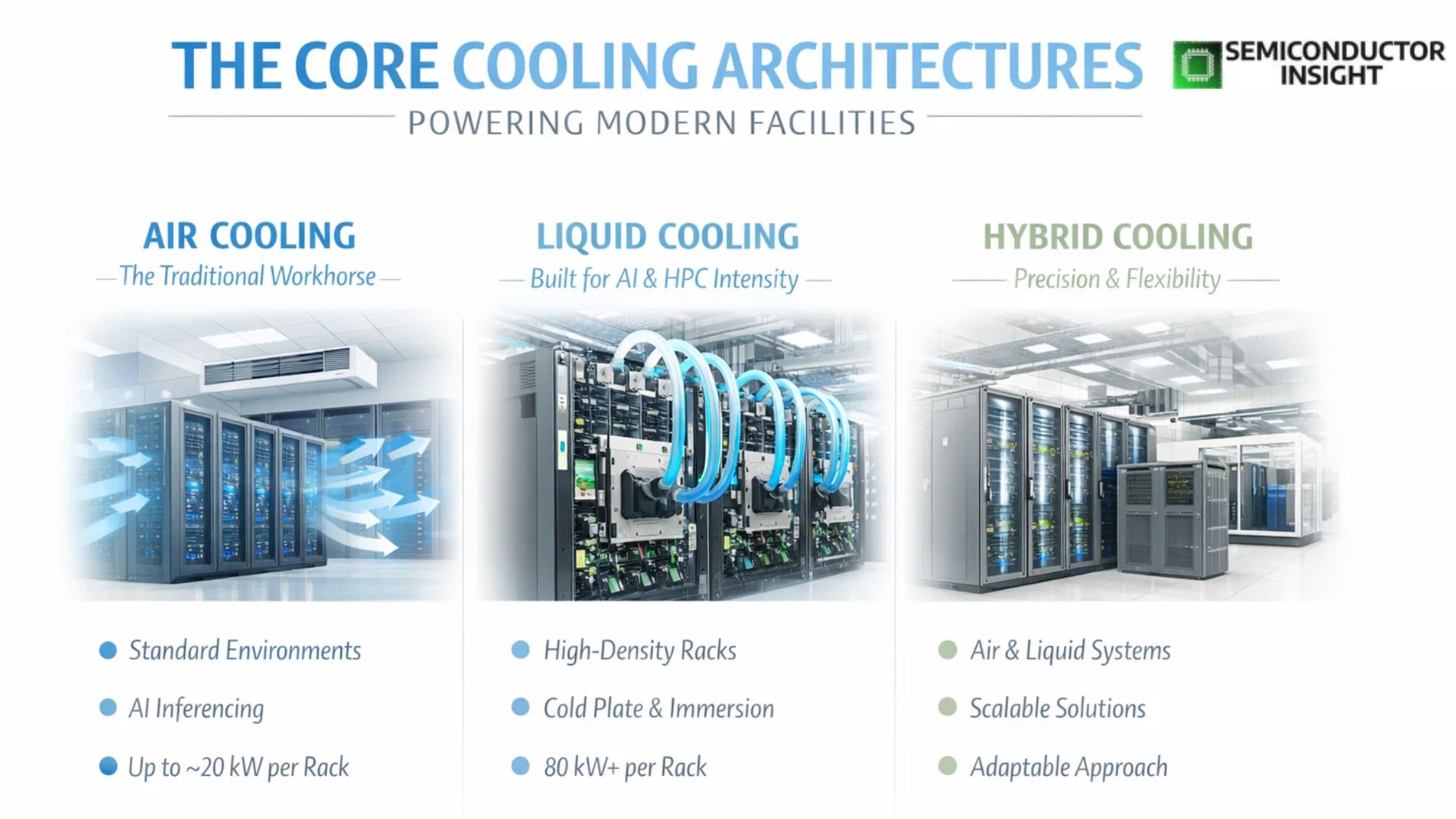
Let’s understand The Core Cooling Architectures Powering Modern Facilities:
— Air Cooling is considered to be the Traditional Workhorse
Air cooling remains the most widely deployed method across conventional facilities. Using CRAC/CRAH units, airflow containment, and high-efficiency fans, this approach circulates conditioned air to remove heat from server racks.
It is best suited for:
- Standard enterprise environments
- AI inferencing workloads
- Deployments below ~20 kW per rack
- Moderate-density colocation setups
In optimized scenarios, advanced air systems can handle up to 30-35 kW per rack. However, beyond this threshold, thermal inefficiencies begin to emerge. While air cooling offers flexibility and broad applicability, it becomes increasingly energy-intensive in high-density AI environments.
— Liquid Cooling helps Built for AI and HPC Intensity
As rack densities surge beyond 40kW and in many AI training environments exceed 80-100 kW liquid cooling has become a transformative solution.
Instead of relying on ambient air, liquid cooling systems circulate coolant directly through cold plates or enclosed systems to absorb and transfer heat efficiently. Because liquids conduct heat significantly better than air, this method allows for:
- Faster heat extraction
- Lower energy consumption in dense clusters
- Reduced reliance on large airflow systems
- Greater rack density optimization
Power-intensive AI training deployments, deep learning models, and generative AI environments especially benefit from liquid-based systems. These workloads demand stable, high-performance thermal management to prevent overheating and maintain computational throughput.
— Hybrid Cooling is where Precision Meets Flexibility
Modern hyperscale and colocation operators are increasingly deploying hybrid cooling systems combining air and liquid technologies within the same facility.
This approach allows operators to:
- Use air cooling for lower-density workloads
- Deploy direct-to-chip or immersion cooling for high-density AI racks
- Optimize energy usage dynamically
- Maintain scalability without full infrastructure overhaul
Hybrid models represent a strategic transition phase, enabling facilities to support next-generation compute demands without abandoning existing infrastructure investments.
Let’s take a brief look at the most significant innovations and advances in 2025-2026:
For instance, in October 2025:
- GS Caltex declared the release of Kixx DLC Fluid PG25, a direct liquid cooling (DLC) system designed to increase data centre energy efficiency.
- With its most recent release, GS Caltex has made two market debuts: DLC and immersion cooling.
- By moving DLC fluid through cooling plates, DLC controls the thermal output of high-heat electrical parts like CPUs and GPUs in servers.
- These two techniques have lately become important technologies in the data centre sector, together with immersion cooling, which immerses electronic equipment in fluid.
For instance, in September 2025:
- Flex, a global manufacturing leader and innovator in data centre infrastructure solutions, declared the release of its newest cooling product, the Modular Rack-Level Cooling Distribution Unit (CDU), which would be available right away.
- This launch is the first phase of Flex’s larger market coverage strategy for cooling distribution units, which was created by JetCool, a Flex firm that specializes in cutting-edge liquid cooling technology.
Why Cooling Strategy Defines Infrastructure Success?
In high-density AI environments, cooling is no longer an operational afterthought it is a competitive differentiator. Facilities that invest in advanced, scalable, and energy-optimized cooling architectures are positioning themselves for long-term resilience in a data-driven world.
As data center capacity grows and AI-driven computing accelerates, cooling decisions directly impact:
- Energy efficiency metrics (PUE performance)
- Operational expenditure
- Hardware longevity
- Sustainability compliance
- Carbon reduction targets
Strategic Breakdown of Data Centre Cooling Market Landscape
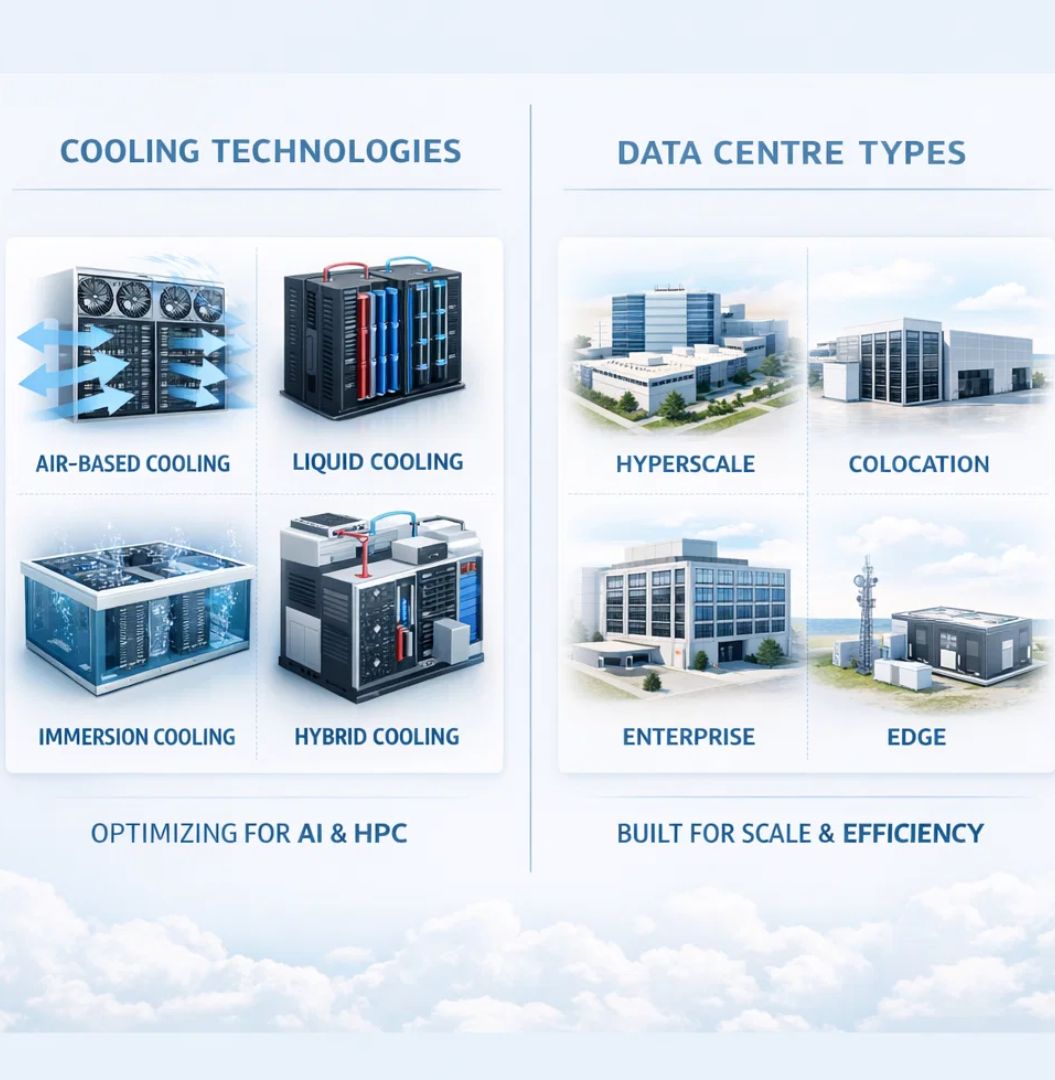
-By Cooling Type:
(Air-Based Cooling Systems, Liquid Cooling Systems, Immersion Cooling, Hybrid Cooling Architectures)
Liquid Cooling Systems are emerging as a transformative force within the Data Centre Cooling Market due to their ability to efficiently manage high rack densities generated by AI, machine learning, and high-performance computing workloads.
Additionally, compared to traditional air-based systems, liquid cooling offers superior heat transfer efficiency, lower energy losses, and improved space optimization. As rack power densities move beyond 30 kW and into AI-driven clusters exceeding 80 kW, liquid and immersion cooling are increasingly transitioning from optional enhancements to foundational infrastructure components in next-generation data centres.
-By Data Centre Type:
(Hyperscale Data Centres, Colocation Facilities, nterprise Data Centres, Edge Data Centres)
Hyperscale Data Centres represent the most influential and capital-intensive segment in the market. These facilities demand scalable, energy-efficient, and high-density cooling frameworks capable of supporting massive cloud ecosystems and AI model training environments.
-By End User:
(Cloud Service Providers, IT & Telecom Companies, BFSI Sector, Government & Research Institutions, Healthcare & Industrial Enterprises)
Cloud Service Providers hold a dominant position in cooling technology adoption due to their continuous expansion of AI infrastructure and hyperscale capacity. Their operations require modular, rapidly deployable cooling systems that maintain uptime reliability while meeting environmental commitments.
Later, growing demand for real-time analytics, 5G networks, and enterprise cloud migration further strengthens the need for advanced thermal management solutions across telecom and financial institutions.
-By Technology:
(Direct-to-Chip Cooling, Rear Door Heat Exchangers, Immersion Cooling, Evaporative & Free Cooling Systems)
Direct-to-Chip Cooling plays a central role in modern high-density deployments as it removes heat directly from processors, significantly enhancing thermal efficiency. Immersion Cooling is gaining strategic importance for extreme-performance computing environments due to its ability to manage ultra-high heat loads while reducing physical footprint.
Meanwhile, free cooling technologies are increasingly adopted in regions with favorable climatic conditions to reduce mechanical cooling dependency and overall energy consumption.
-By Sustainability Integration:
(Water-Efficient Cooling Systems, Heat Reuse & Recovery Solutions, Low-GWP Refrigerant Systems, AI-Based Cooling Optimization Platforms)
AI-Based Cooling Optimization Platforms are redefining operational efficiency by dynamically adjusting airflow, coolant flow rates, and system load distribution in real time. These systems not only reduce energy consumption but also enable predictive maintenance, minimizing downtime risks.
How Data Center Infrastructure Management (DCIM) Software Impacts the Cooling System?
The ideal Data Center Infrastructure Management (DCIM) solution optimizes the data center’s energy use, asset utilization and performance, as well as space utilization, which are all important elements of the cooling system. DCIM collects, reports, and trends on data from environmental sensors such as humidity and temperature.
This allows managers to obtain a clearer understanding of when to alter temperature set points and simplify how they manage airside economization. DCIM makes it easy to visualize hotspots with thermal time-lapse video, avoid overcooling and wasting energy resources, keep cabinets within ASHRAE guidelines, and increase data centre sustainability.
Get Sample Report to find out what’s changing the market: https://semiconductorinsight.com/download-sample-report/?product_id=136000
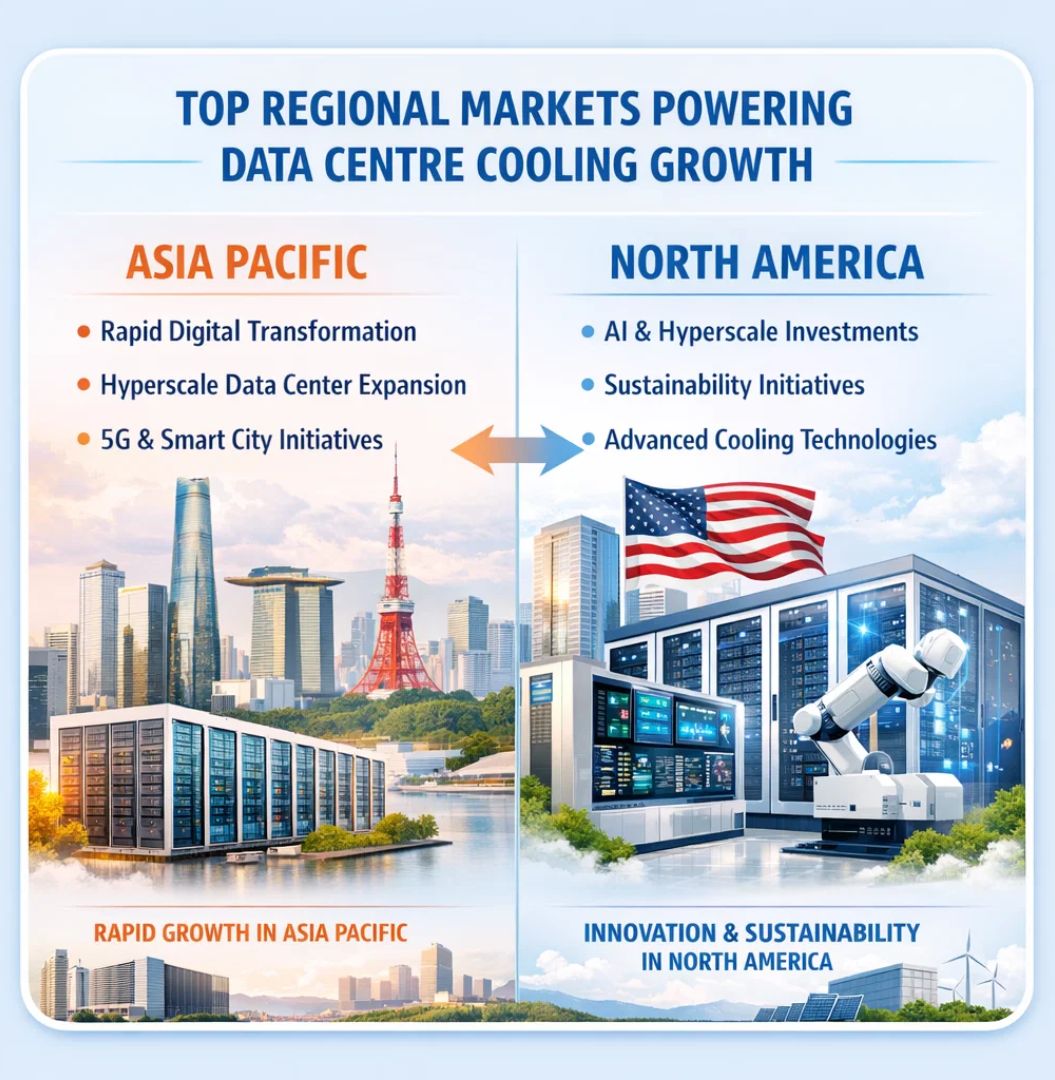
Top Two Regional Markets Powering Data Centre Cooling Industry Growth
— Asia Pacific
Asia Pacific is emerging as a powerhouse in the Data Centre Cooling Market due to rapid digital transformation, expanding cloud ecosystems, and aggressive hyperscale construction across countries such as China, India, Japan, and Singapore. Governments across the region are actively supporting data localization policies, smart city initiatives, and 5G rollout programs, which are significantly increasing demand for large-scale data center infrastructure.
The region benefits from strong manufacturing ecosystems, particularly in China and Southeast Asia, enabling cost-effective production of cooling equipment, chillers, and precision air conditioning systems. Additionally, the rise of AI startups, fintech platforms, and e-commerce giants is pushing operators to deploy high-density facilities that require advanced liquid and hybrid cooling technologies. Rapid urbanization combined with favorable industrial policies continues to strengthen Asia Pacific’s leadership position in next-generation cooling deployments.
— North America
North America remains a technology innovation hub, with the United States leading in hyperscale expansion and AI infrastructure investments. Major cloud providers and colocation operators are heavily investing in direct-to-chip cooling, advanced containment systems, and AI-driven thermal optimization software. Regulatory pressure around sustainability, combined with corporate net-zero commitments, is accelerating the shift toward water-efficient systems and low-GWP refrigerants.
The Power behind North America’s Economic Leadership:
- High concentration of hyperscale and AI-driven data center campuses
- Early and aggressive adoption of liquid cooling and immersion technologies
- Strong regulatory emphasis on energy efficiency and carbon reduction targets
- Growing focus on reducing Power Usage Effectiveness (PUE) ratios
- Presence of major cloud operators and advanced cooling technology providers
–Market Leadership and Innovation Landscape
- Vertiv
- Stulz
- Envicool
- Schneider Electric
- Rittal
- Mitsubishi Electric
- Shenling
- YMK
- Huawei
- Canatal
- iTeaq
- Airsys
- Airedale
- Asetek
- Green Revolution Cooling
Go through some of the major data center cooling products from Schneider Electric;
- Server Room Air Conditioners
- Coolant Distribution Units
- Chillers and heat rejection
- Uniflair coolant distribution
- Others
Forecasted Expansion and Next Generation Cooling Technologies for Data Centers
Data Centre Cooling Market is entering a phase of accelerated structural transformation, fueled by the rapid expansion of artificial intelligence workloads, hyperscale cloud deployments, and edge computing ecosystems. As rack densities continue to rise and computing environments become more performance intensive, advanced thermal management is becoming a foundational requirement rather than a supporting utility.
A significant portion of total data center energy consumption is linked directly to cooling infrastructure, pushing operators to adopt more efficient and intelligent systems. The long-term outlook is strongly shaped by the transition from conventional air-based cooling toward liquid cooling, immersion technologies, and hybrid architectures designed for high-density computing environments.
In the coming years, cooling systems will evolve into strategic performance enablers supporting scalability, operational resilience, and environmentally responsible digital growth across global data center networks.
Access Actionable Insights from Our Extended Research Portfolio:
-Immersion Cooling For Data Centers Market: https://www.24chemicalresearch.com/reports/265323/global-immersion-cooling-for-data-centers-market-2024-2030-336
-Data Center Cooling Equipment Market: https://www.statsmarketresearch.com/global-data-center-cooling-equipment-forecast-market-8070065
-Cooling Tower for Data Center Market: https://www.intelmarketresearch.com/cooling-tower-for-data-center-market-25091
About Semiconductor Insight
Semiconductor Insight is a leading provider of market intelligence and strategic consulting for the global semiconductor and high-technology industries. Our in-depth reports and analysis offer actionable insights to help businesses navigate complex market dynamics, identify growth opportunities, and make informed decisions. We are committed to delivering high-quality, data-driven research to our clients worldwide.
International: +91 8087992013
SemiconductorInsight
[email protected]
203A, City Vista, Fountain Road, Kharadi, Pune, India – 411014.
https://semiconductorinsight.com/
This article was originally published by IssueWire. Read the original article here.