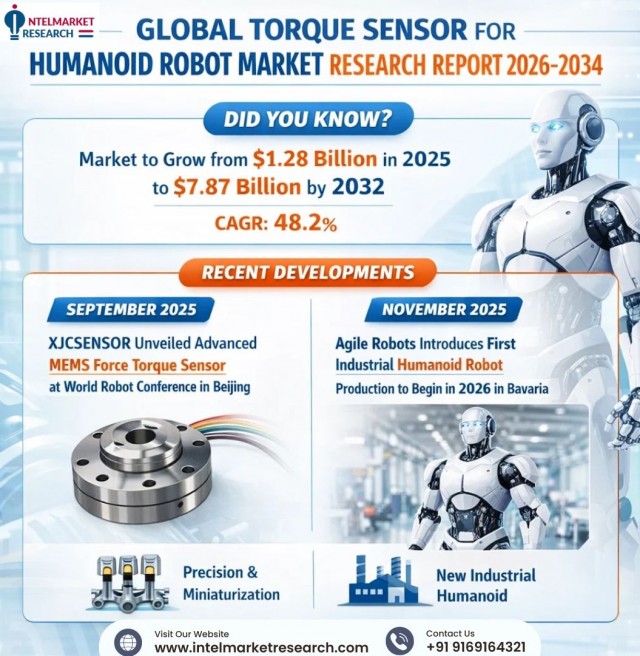
The market is projected to grow from USD 1.28 billion in 2025 to USD 7.87 billion by 2032, reflecting a strong 48.2% CAGR driven by rising humanoid robot deployment.
(Isstories Editorial):- Pune, Maharashtra Feb 19, 2026 (Issuewire.com) – Torque sensor for humanoid robot market is projected to grow from USD 1.28 billion in 2025 to USD 7.87 billion by 2032, exhibiting a remarkable compound annual growth rate (CAGR) of 48.2% during the forecast period. The rapid expansion reflects accelerating investments in humanoid robotics, industrial automation, and intelligent sensing technologies worldwide.
More on Isstories:
- Global Torque Sensor for Humanoid Robot Market to Reach USD 7.87 Billion by 2032 at 48.2% CAGR
- From Snacks to Solutions: How Swasthum Is Rewriting India’s Functional Food Story
- Crush Excavation Supports Septic Planning for Rural Properties Near Aurora Ahead of Peak Season
- NANDO raises €3.3 million to revolutionize waste management with AI
- GenoMirai Genome Analysis Platform Introduced in Tokyo
Torque sensors are emerging as a foundational component in the development of next-generation humanoid robots. Unlike basic motion sensors, torque sensors measure precise force applied at critical robotic joints such as shoulders, elbows, hips, knees, wrists, and ankles. This capability enables robots to maintain balance, execute controlled movements, and safely interact with humans and objects in real-world environments. As humanoid robots transition from research labs to industrial floors, high-precision torque sensing is becoming indispensable.
-Get Full Access to the Detailed Report: https://www.intelmarketresearch.com/torque-sensor-for-humanoid-robot-market-2830
Rising Adoption of Humanoid Robots Driving Market Growth
The increasing deployment of humanoid robots across industrial automation environments is a major factor contributing to market growth. Manufacturers are integrating humanoid robots into assembly lines to perform complex tasks requiring delicate handling, adaptive force control, and collaborative interaction with human workers. Precise torque feedback allows robots to replicate human-like dexterity while minimizing the risk of component damage or workplace accidents.
Automotive and electronics manufacturers are among the leading adopters, leveraging torque sensor-enabled humanoids for tasks such as intricate assembly, quality inspection, and material handling. As production systems become more flexible and customized, demand for advanced sensing solutions continues to accelerate.
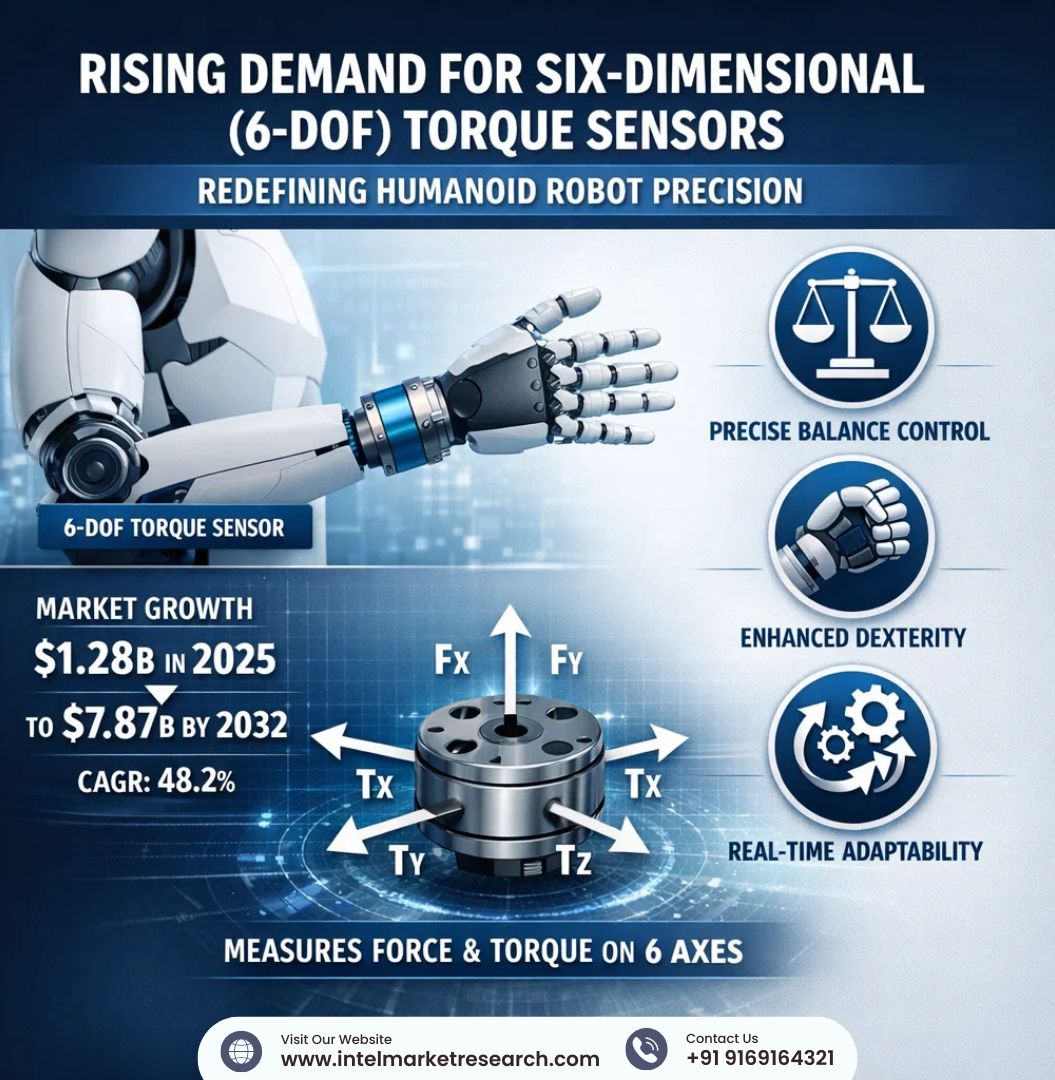
Six-Dimensional (6-DoF) Torque Sensors Redefining Humanoid Robot Precision
Six-dimensional, or six-degree-of-freedom (6-DoF), torque sensors are emerging as a critical innovation in the global torque sensor for humanoid robot market, which is projected to grow from USD 1.28 billion in 2025 to USD 7.87 billion by 2032 at a CAGR of 48.2%. These advanced sensors measure forces and torques across three axes simultaneously, enabling humanoid robots to detect multi-directional loads in real time.
Unlike single-axis systems, six-dimensional torque sensors provide comprehensive force feedback essential for maintaining balance, executing precise manipulation, and adapting instantly to environmental changes. This capability is particularly important for humanoid robot joints such as wrists, ankles, and fingers, where complex motion and stability control are required.
As industrial automation accelerates and humanoid robots are deployed in manufacturing, healthcare, and service environments, 6-DoF torque sensing technology is becoming a core enabler of safe human-robot collaboration. Although these sensors involve higher development and calibration costs, their superior performance and accuracy are expected to support long-term adoption across advanced robotic systems.
Cost and Calibration Challenges Remain Key Restraints
Despite strong growth prospects, the market faces certain technical and economic challenges. Advanced six-axis torque sensors, which measure forces and torques across three dimensions, remain significantly more expensive than single-axis alternatives. Their higher costs are attributed to complex manufacturing processes involving precision-machined elastomers and specialized strain gauge configurations.
Additionally, calibration requirements and integration complexity can extend development cycles for humanoid robot manufacturers. These factors may limit adoption among smaller robotics developers or cost-sensitive industries in the short term.
Technological Advancements Strengthen Innovation Landscape
January 2026: Advancements in 6D Force/Torque Sensing at CES 2026
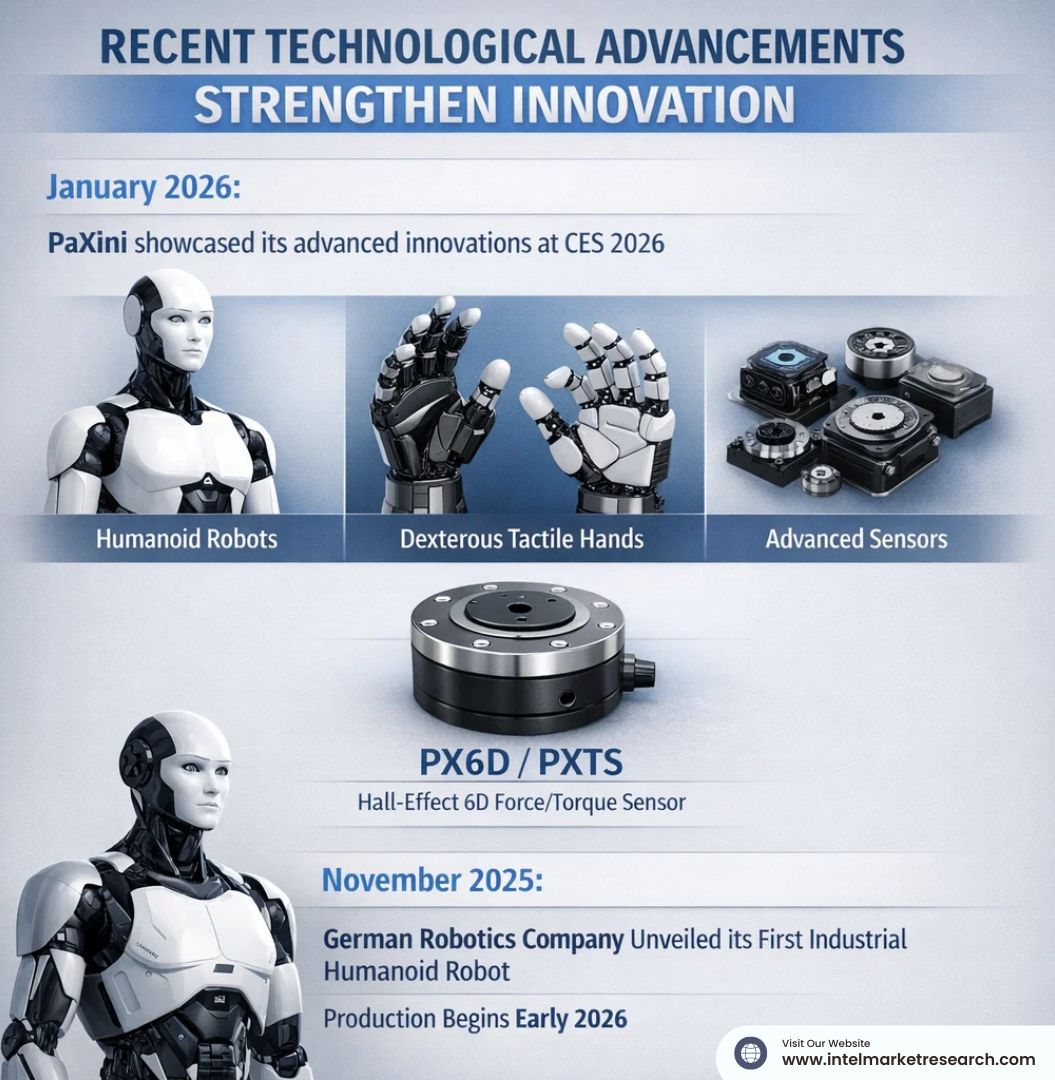
- In January 2026, PaXini, recognized for its high-precision tactile perception and embodied AI solutions, showcased its comprehensive product portfolio at CES 2026. The company presented humanoid robots, multi-dimensional tactile dexterous hands, full-body six-axis force/torque (F/T) sensor ecosystems, and an omni-modality data acquisition platform designed to enhance robotic perception and interaction capabilities.
A key highlight of the presentation was the introduction of the PX6D/PXTS, described as the first commercial Hall-effect 6D force/torque sensor developed specifically for embodied AI applications. The sensor integrates on-device intelligence within a lightweight architecture, aiming to improve real-time force feedback, system responsiveness, and precision control in humanoid robotic systems.
Recent industry developments highlight continued innovation in force sensing technology.
- In September 2025, a MEMS-based force torque sensor was introduced at the World Robot Conference in Beijing, designed to enhance precision and miniaturization for robotic applications such as fingers and wrists.
- In November 2025, a German robotics company unveiled its first industrial humanoid robot equipped with highly dexterous hands incorporating force-torque and fingertip sensors. Production is expected to begin in early 2026.
Additionally, advancements in six-degree-of-freedom (6-DoF) torque sensors are expanding robotic touch capabilities, enabling machines to sense and adapt to their environments in real time. Chinese manufacturers have also introduced new six-axis force/torque sensors targeting robotic joints including fingers, wrists, and ankles to support industrial-scale humanoid deployment.
Segment Analysis
By Type:
Six-axis torque sensors represent the most advanced segment, offering comprehensive measurement of forces and torques in three dimensions. These sensors are critical for complex humanoid applications requiring sophisticated interaction and dynamic balance.
By Application:
Industrial applications currently dominate the market due to increasing integration of humanoid robots in manufacturing environments requiring precise force control and collaborative automation.
By Technology:
Strain gauge-based torque sensors remain the most widely adopted technology, valued for reliability, high accuracy, and cost-effectiveness in converting mechanical deformation into electrical signals.
By End User:
Automotive manufacturers represent the largest end-user segment, deploying torque sensor-equipped humanoid robots for assembly tasks demanding delicate handling and precision.
-Download the Sample Report and see what’s driving the market: https://www.intelmarketresearch.com/download-free-sample/11332/humanoid-robot-market
Regional Insights
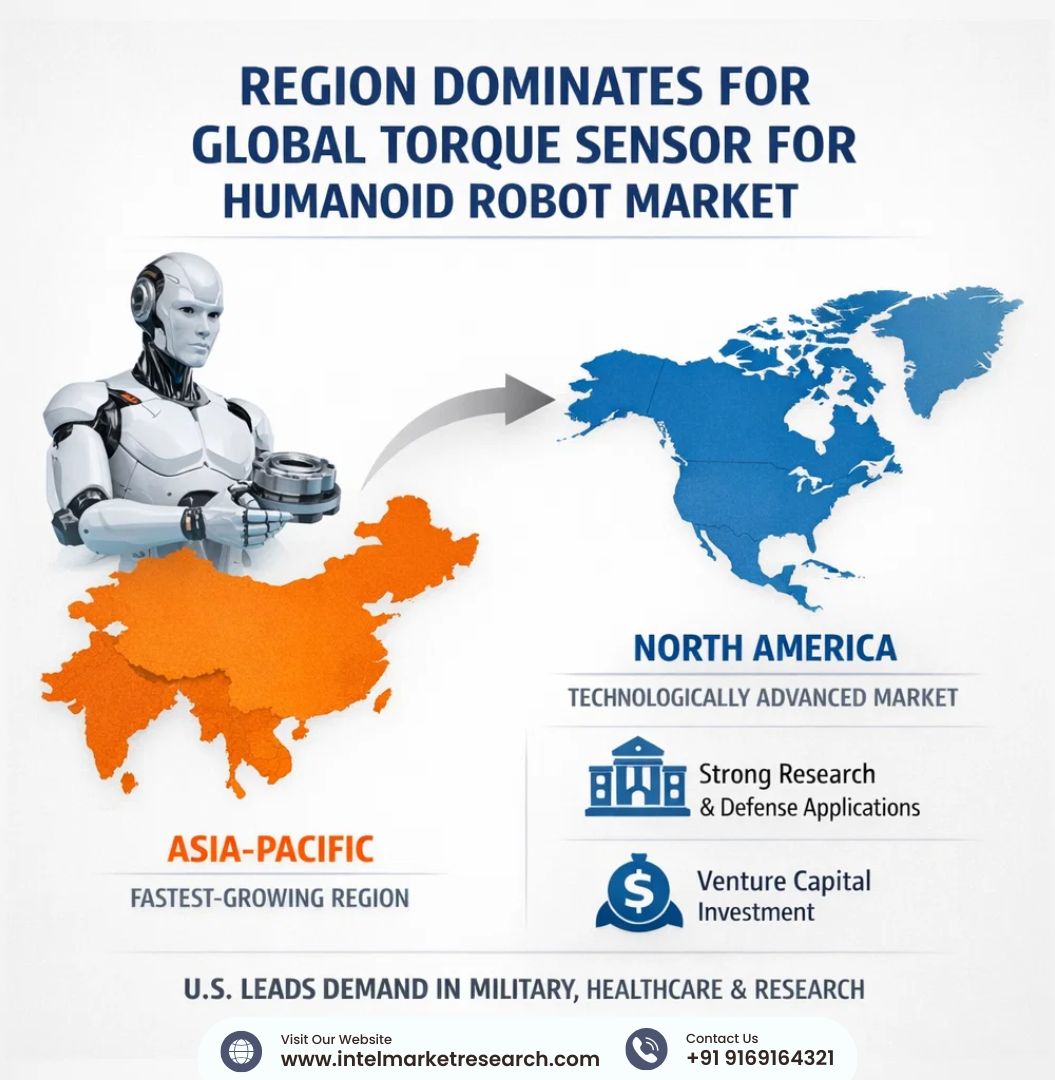
Asia-Pacific leads the global torque sensor for humanoid robot market, supported by strong manufacturing capabilities, government-backed robotics initiatives, and extensive R&D investments. The region benefits from a well-established robotics ecosystem and rapid technological adoption.
North America represents a technologically advanced market characterized by strong academic research, defense applications, and venture capital investment inrobotics startups. The United States leads regional demand, particularly in military, healthcare, and research applications requiring high-precision sensing.
Europe maintains a strong position through its expertise in precision engineering and industrial automation. Countries such as Germany and Switzerland are prominent in developing high-quality torque sensors for research and industrial humanoid robots.
Competitive Landscape
Key companies profiled in the torque sensor for humanoid robot market include:
- Bota Systems (Switzerland)
- ATI Industrial Automation (U.S.)
- Robotous (South Korea)
- Keli Sensing Technology (China)
- Ampelion (Germany)
- Guangzhou Haozhi Industrial Co., Ltd. (China)
- Futek Advanced Sensor Technology (U.S.)
- OnRobot (Denmark)
- TE Connectivity (Switzerland)
These companies focus on product innovation, miniaturization, improved calibration systems, and strategic partnerships to strengthen their market position.
-Learn More in the Full Market Report: https://www.intelmarketresearch.com/torque-sensor-for-humanoid-robot-market-2830
Possible Directions for the Path Ahead:
With humanoid robots advancing toward wider industrial and service adoption, torque sensors are becoming a core enabling technology. The projected growth from USD 1.28 billion in 2025 to USD 7.87 billion by 2032 at a CAGR of 48.2% reflects the critical role of precision force measurement in the future of intelligent robotics. While cost and technical complexities remain challenges, ongoing technological innovation and expanding industrial deployment are expected to support sustained market expansion throughout the forecast period.
Explore our related reports:
About us:
Intel Market Research is a leading provider of strategic intelligence, offering actionable insights in biotechnology, pharmaceuticals, and healthcare infrastructure. Our research capabilities include:
- Real-time competitive benchmarking
- Global clinical trial pipeline monitoring
- Country-specific regulatory and pricing analysis
- Over 500+ healthcare reports annually
Trusted by Fortune 500 companies, our insights empower decision-makers to drive innovation with confidence.
Website: https://www.intelmarketresearch.com
Asia-Pacific: +91 9169164321

Intel Market Research
*****@intelmarketresearch.com
09169162030
203A, City Vista, Fountain Road, Kharadi, Pune, India – 411014
http://www.intelmarketresearch.com

This article was originally published by IssueWire. Read the original article here.