(Isstories Editorial):- Shenzhen, Guangdong Jan 23, 2026 (Issuewire.com) – How can international retailers distinguish between mere timekeeping devices and true horological value in an increasingly saturated global market? What specific benchmarks determine the longevity and marketability of a timepiece in today’s competitive retail landscape? Why is the choice of a manufacturing partner often more critical than the design itself? As the horology industry shifts toward a blend of traditional craftsmanship and modern utility, identifying a Global Leading Best Wrist Watch For Men Supplier has become the cornerstone of success for distributors and brand owners worldwide.
A wrist watch is no longer just a tool for tracking hours; it is a versatile accessory that bridges the gap between functional utility in professional settings and personal expression in social environments. Whether it is a high-precision mechanical piece for a boardroom or a rugged digital model for outdoor exploration, the application scenarios for timepieces have expanded, demanding higher standards of durability and aesthetic versatility.
Global Horology Market and Emerging Buyer Pain Points
More on Isstories:
- From Concept to Reality: How Our OEM/ODM Services Revolutionize Custom Stainless Steel Trash Bins Designs for Modern Bra
- Roscommon Systems Launches LIMA, an AI-powered Screen Reader for Low-vision Users
- Serena Ibrahim, Recognized by BestAgents.us as a 2026 Top Agent
- Yijiang Machinery: Delivering Excellence as China Best Track Undercarriage Supplier
- Toni Effingger, Recognized by BestAgents.us as a 2026 Top Agent
While the surge of smart technology initially threatened traditional segments, there has been a significant “mechanical renaissance” among male consumers who value tangibility, heritage, and mechanical complexity. However, this growth brings challenges. International buyers frequently encounter pain points such as inconsistent manufacturing quality, lack of original design IP, and the inability of suppliers to scale production without compromising detail. Furthermore, the “Quartz Crisis” of the past has evolved into a “Transparency Crisis” where buyers struggle to verify the origins of materials and the ethical standards of production facilities.
Geographically, the demand remains robust across North America and Europe, with a burgeoning middle class in Southeast Asia driving a new appetite for luxury-style business watches. While Switzerland remains the historic heart of high-end horology and Japan leads in movement innovation, China has solidified its position as the indispensable engine of global watch production. Specifically, Shenzhen has emerged as a premier hub, housing sophisticated ecosystems that allow a wrist watch supplier to integrate design, component sourcing, and assembly with unparalleled efficiency. For international buyers, navigating this landscape requires a shift from price-centric sourcing to a value-driven partnership model.
The Four Pillars of Strategic Sourcing for International Buyers
To thrive in the current market, professional buyers must evaluate potential partners through a lens of long-term viability. The following criteria represent the modern standard for excellence in the watch manufacturing industry.
Stringent Quality Control and the Art of Precision Craftsmanship
In the world of horology, a fraction of a millimeter can be the difference between a masterpiece and a defect. International buyers should prioritize a wrist watch supplier that demonstrates a mastery of materials and assembly. True quality begins with the selection of raw materials, such as 316L stainless steel for its corrosion resistance and hypoallergenic properties, and sapphire crystal for its scratch-resistant clarity.
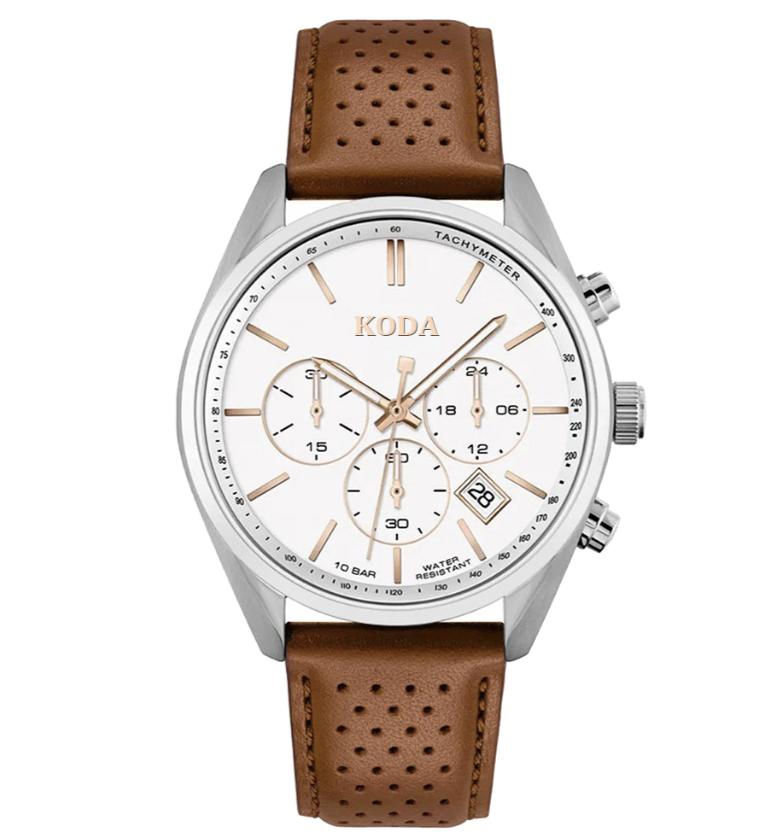
The technical prowess of Shenzhen Koda Horologe Co., Ltd. (KODA) serves as a benchmark in this regard. With nearly 20 years of specialized experience, the company operates from a 1,000-square-meter facility in Shenzhen, where precision is a mandate rather than an option. For instance, in the production of luxury men’s 42mm automatic mechanical watches, the integration of high-beat movements requires a dust-free environment and rigorous testing for water resistance–often reaching 5ATM or 10ATM. A reputable partner ensures that the best wrist watch for men is not only aesthetically pleasing but also technically sound, undergoing multi-stage inspections that cover movement accuracy, vacuum plating durability, and strap tensile strength. This level of craftsmanship ensures that products can withstand the rigors of daily wear while maintaining their luster.
Design Innovation and the Necessity of Brand Flexibility
The modern consumer is notoriously fickle, with trends moving from minimalist “Bauhaus” styles to bold, oversized “Sport-Luxe” aesthetics within a single season. Consequently, a vital selection criterion is a manufacturer’s ability to offer both original design manufacturing (ODM) and original equipment manufacturing (OEM) services. Buyers need a partner that doesn’t just copy existing trends but anticipates them.
A leading wrist watch supplier must maintain a diverse portfolio that includes quartz, stainless steel, and digital models. The ability to customize components–from the dial texture and hand shape to the placement of a brand logo–allows international buyers to maintain a unique brand identity. KODA exemplifies this flexibility by specializing in a wide range of styles, including fashion-forward quartz watches and rugged digital sports models. By offering low minimum order quantities (MOQ) for customized logos, they empower smaller boutique brands to compete with established giants, providing the best wrist watch for men that aligns perfectly with specific market niches, whether it be luxury business fashion or high-performance waterproof sports gear.
Large-Scale Production Capacity and Supply Chain Resilience
For international buyers, the ability to scale is often a primary bottleneck. A supplier may produce an excellent prototype, but maintaining that quality across a 10,000-unit production run is a different challenge entirely. Buyers must assess the scale of the factory and the stability of its upstream supply chain.
Operating in the heart of China’s manufacturing sector, KODA leverages the logistical advantages of Shenzhen to ensure a steady flow of high-quality components, from Japanese Miyota or Seiko movements to premium leather and silicone straps. A professional wrist watch supplier possesses the infrastructure to handle large-scale orders while maintaining the agility to pivot production lines as needed. This supply chain stability is crucial for meeting seasonal demand peaks, such as the holiday shopping periods in the West, ensuring that retailers are never left with empty shelves due to production delays or component shortages.
Sustainability and the Ethical Imperative in Modern Manufacturing
The modern international buyer is increasingly held accountable for the ethical footprint of their products. Sustainable sourcing and ethical labor practices are no longer “optional extras” but are essential for brand reputation. This includes the use of recyclable materials, the reduction of chemical waste in the plating process, and ensuring fair labor conditions within the factory.
A commitment to “Made in China” excellence now involves adhering to international standards of social responsibility. Buyers should look for partners who view watchmaking as a legacy craft–one that respects both the artisan and the environment. By focusing on durable materials like high-grade stainless steel and long-life movements, a wrist watch supplier contributes to a “slow fashion” movement, creating products that last for years rather than months. This commitment to longevity is the ultimate form of sustainability. When a buyer selects the best wrist watch for men from a manufacturer that values ethical production, they are investing in a product that resonates with the values of the modern, conscious consumer.
Conclusion: Navigating the Future of the Timepiece Industry
The path to domestic and international market leadership in the watch industry is paved with precision, innovation, and strategic partnership. By focusing on the essential criteria of quality control, design flexibility, production scale, and ethical standards, international buyers can navigate the complexities of the global market with confidence. Partners like Shenzhen Koda Horologe Co., Ltd. (KODA) represent the synthesis of nearly two decades of experience and modern manufacturing efficiency, providing the reliability required to sustain a global brand. As the industry continues to evolve, the distinction between a simple vendor and a strategic wrist watch supplier will remain the ultimate deciding factor in horological success.
To learn more about the product information of Koda, please visit: https://www.kodawatch.com/.
Shenzhen Koda Horologe Co., Ltd.
[email protected]
204, Building A, Suojia Science Park, Sanwei community, Xixiang, Bao’an District, 518126 Shenzhen, Guangdong, China
https://www.kodawatch.com/
This article was originally published by IssueWire. Read the original article here.